
Wertheim National Wildlife Refuge
Wertheim National Wildlife Refuge is a 2,550-acre protected natural area in Shirley, on the South Shore of Suffolk County within the Town of Brookhaven. Centered around the Carmans River, the refuge protects an unusually diverse landscape of oak-pine woodland, grasslands, ponds, streams, tidal areas, and fresh, brackish and saltwater wetlands.
Established in 1947 and managed by the U.S. Fish and Wildlife Service, Wertheim is one of Long Island’s most important wildlife habitats and one of the more accessible places on the Island to experience the Carmans River environment. Visitors can hike, watch birds and other wildlife, take photographs, fish, paddle the river, and explore an educational visitor center that also serves as headquarters for the Long Island National Wildlife Refuge Complex.
The Carmans River
The Carmans River is the defining natural feature of Wertheim National Wildlife Refuge, running through the protected property before eventually reaching Bellport Bay and the Great South Bay system. It is one of Long Island’s largest rivers and is designated by New York State as a scenic river.
Much of the experience at Wertheim revolves around the river and the wetlands surrounding it. Forest gives way to marshland and open water, creating habitat for waterfowl, wading birds, fish, turtles, amphibians and mammals. Farther south, the river and its tidal environment become part of the coastal landscape associated with Bellport, Bellport Bay and the Great South Bay.
Several overlooks along the refuge’s trails provide views across the Carmans River and surrounding marshes. These are particularly good places to stop quietly with binoculars or a camera and watch for wildlife.
The river also makes Wertheim an important paddling destination. Canoes and kayaks allow visitors to see portions of the refuge from an entirely different perspective, although paddlers should follow current U.S. Fish and Wildlife Service access rules and avoid landing along protected refuge shorelines where landing is prohibited.
Hiking Trails
Wertheim has more than six miles of trails and walking routes through woodland, wetland and riverfront environments. The terrain is generally relatively flat, making the refuge suitable for visitors looking for nature walks rather than strenuous hiking.
The two principal trails are the White Oak Nature Trail and Black Tupelo Trail.
The White Oak Nature Trail begins near the refuge facilities and offers both shorter and longer walking options. The current U.S. Fish and Wildlife Service trail information lists a short loop of approximately 1.25 miles and a long loop of approximately 2 miles. The route passes through woodland and provides access to several areas overlooking the Carmans River.
The Black Tupelo Trail begins at the visitor center and extends approximately 3.3 miles. It explores the eastern side of the Carmans River and provides another opportunity to experience the refuge’s forest, wetlands and river scenery.
Four Carmans River overlooks along the trail system are considered particularly good wildlife-viewing locations.
Visitors should remember that Wertheim is managed first as wildlife habitat rather than as a conventional recreational park. Staying on established trails helps protect sensitive areas and also reduces exposure to ticks and poison ivy.
Wildlife and Birdwatching
Wertheim National Wildlife Refuge is one of Long Island’s significant bird habitats because of its location along the Atlantic Flyway and the combination of river, marsh, forest, grassland and coastal environments found within a relatively compact area.
Waterfowl are especially prominent during the colder months. Black ducks, bufflehead, mergansers and other ducks use the Carmans River and surrounding wetlands, while great blue herons and other wading birds can often be found around shallow water and marsh edges.
Ospreys return during spring and can be seen around the river, while migrating songbirds bring additional activity to the refuge’s forests. Raptors, shorebirds, wild turkeys and numerous other species may also be encountered depending on the season.
Birding changes considerably throughout the year. Late October through early April is considered one of the best periods for viewing waterfowl, while spring brings warblers and other migrating songbirds. Fall migration provides another opportunity to see birds passing through Long Island on their seasonal journeys.
Wertheim is not limited to birds. White-tailed deer, red foxes, muskrats, turtles, frogs and numerous fish species inhabit the refuge. Eastern box turtles are sometimes encountered along trails and refuge roads during the warmer months.
Wildlife sightings are never guaranteed, but the combination of extensive protected habitat and relatively easy trail access makes Wertheim an excellent place for patient wildlife observation.
Visitor Center
The Long Island National Wildlife Refuge Complex Headquarters and Visitor Center is located at Wertheim at 340 Smith Road in Shirley.
The visitor center is more than an information desk. Exhibits introduce visitors to Long Island’s different ecosystems and wildlife and include habitat displays, interactive educational features and information about the other federally managed wildlife refuges on Long Island.
The building is a useful first stop for families and first-time visitors who want to understand what they may encounter before heading onto the trails. A nature store operated by Friends of Wertheim Refuge is also located at the visitor center.
Public restrooms are available, including facilities near the beginning of the White Oak trail.
The visitor center is currently open Monday through Saturday from 9 a.m. to 4 p.m. Refuge trails are open seven days a week from sunrise to sunset. Hours, programs and temporary closures can change, so visitors making a special trip should confirm current conditions with the U.S. Fish and Wildlife Service.
Fishing and Paddling
The Carmans River provides opportunities for both freshwater and tidal fishing as it passes through different environments on its way toward the bay.
Species associated with the river and refuge waters include striped bass, weakfish, white perch, largemouth bass, carp and several trout species.
Fishing from a boat is permitted in portions of the Carmans River under refuge regulations, although fishing is restricted in certain areas, including Big Fish Creek Pond. Fishing from refuge riverbanks is more restricted, so anglers should check current regulations before choosing a location.
Non-motorized boating is another popular way to experience the Carmans River. Canoes and kayaks are particularly well suited to the relatively quiet waterway and provide opportunities for wildlife viewing that cannot always be duplicated from land. The refuge is part of a much larger South Shore environment where paddling, boating and fishing are closely connected to the rivers, wetlands and bays feeding the Great South Bay.
Because the river passes through environmentally sensitive habitat, paddlers should observe all posted refuge boundaries, landing restrictions and wildlife protection rules.
Photography
Wertheim is particularly well suited to nature and wildlife photography. The Carmans River overlooks provide broad views across marshes and waterways, while the forests and wetlands offer opportunities to photograph birds, deer, turtles, seasonal plants and changing foliage.
Early morning and later afternoon can provide favorable light and increased wildlife activity. Long lenses or binoculars are useful because visitors should never approach wildlife simply to obtain a closer photograph.
Spring brings wildflowers and fresh vegetation, while autumn changes the refuge’s oak and woodland landscape. Winter provides a much more open view through leafless forests and coincides with some of the refuge’s strongest waterfowl activity.
History of Wertheim National Wildlife Refuge
The refuge traces its origins to Maurice Wertheim, a New York investment banker, philanthropist and conservationist who owned approximately 1,800 acres along the Carmans River.
Wertheim used the property for conservation as well as hunting and fishing. In 1947, Maurice Wertheim and his wife, Cecile, donated the property to the United States government for the benefit of the American people.
The refuge subsequently expanded beyond the original donation and today protects approximately 2,550 acres.
Its creation preserved a substantial portion of the Carmans River corridor from development and helped protect an interconnected landscape of forests, wetlands and tidal habitat that has become increasingly valuable as surrounding areas of Long Island have grown.
Today the refuge forms part of the Long Island National Wildlife Refuge Complex, a network of federally protected habitats established to conserve wildlife and some of the Island’s remaining significant natural areas.
Best Times to Visit
Wertheim can be visited throughout the year, but each season offers a different experience.
Spring is particularly good for migrating songbirds, returning ospreys, wildflowers, turtles and amphibian activity. Summer provides lush vegetation and active wildlife but can also bring mosquitoes, biting flies and ticks.
Autumn combines fall foliage with bird migration and generally comfortable hiking conditions. Winter is one of the best seasons for waterfowl viewing along the Carmans River, with ducks, geese and other waterbirds congregating around open water.
For wildlife watching, quieter periods near the beginning and end of the day can be particularly rewarding.
Know Before You Go
Wertheim is a wildlife refuge rather than a general-purpose municipal park, and activities are managed around the protection of wildlife and habitat.
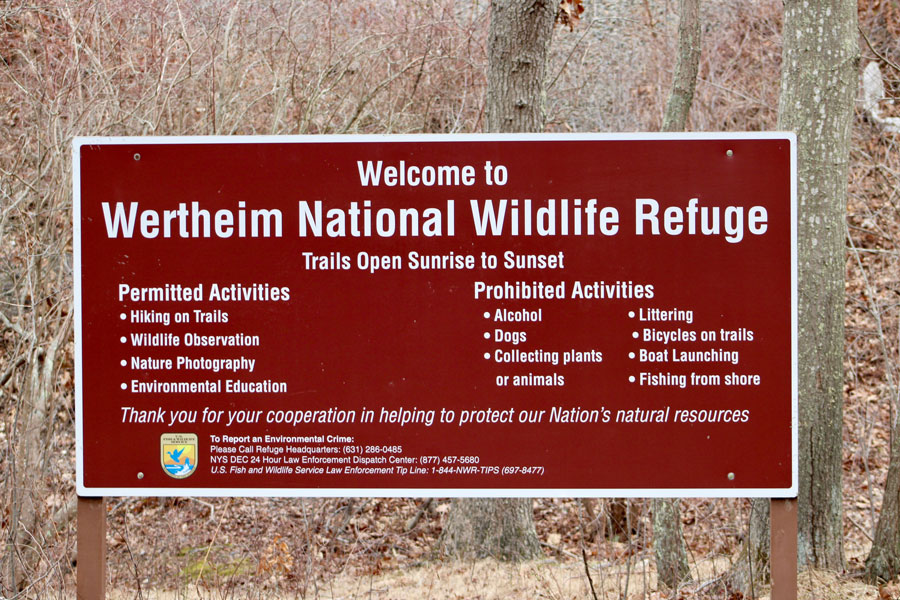
Trails are open daily from sunrise to sunset. Visitors should remain on designated trails, observe posted restrictions and avoid disturbing wildlife. Bicycles and pets are not permitted on refuge trails.
Ticks, poison ivy, mosquitoes and biting flies are all possible, particularly during warmer months. Insect repellent, appropriate footwear and seasonal tick precautions are recommended.
Hunting is permitted in designated portions of Wertheim during regulated seasons under specific refuge requirements. Visitors planning fall or winter hikes should pay attention to posted hunting notices and any temporary trail restrictions.
There is no need to travel deep into the refuge to enjoy it. The visitor center, relatively flat trails and Carmans River overlooks make Wertheim accessible to casual visitors as well as dedicated birders and naturalists.
Getting There
The primary visitor entrance is located at:
Wertheim National Wildlife Refuge
340 Smith Road
Shirley, NY 11967
Phone: 631-286-0485
From the Long Island Expressway (I-495), visitors can take Exit 68S to William Floyd Parkway, continue south to Montauk Highway and then turn onto Smith Road.
From Sunrise Highway, take Exit 58S toward William Floyd Parkway and continue toward Montauk Highway and Smith Road.
The refuge can also be reached using public transportation. The Mastic–Shirley station on the Long Island Rail Road’s Montauk Branch is approximately one mile from the visitor center. Suffolk County Transit routes serving Montauk Highway also stop roughly a mile from the refuge.
Wertheim National Wildlife Refuge
Key Facts & Details
| Category | Details |
|---|---|
| Location | 340 Smith Road, Shirley, NY 11967 |
| County | Suffolk County |
| Town | Town of Brookhaven |
| Type | National Wildlife Refuge |
| Established | 1947 |
| Size | Approximately 2,550 acres |
| Managed By | U.S. Fish and Wildlife Service |
| Major Waterway | Carmans River |
| Habitats | Oak-pine woodland, grassland, ponds, streams, freshwater wetlands, brackish marsh and saltwater wetlands |
| Main Trails | White Oak Nature Trail and Black Tupelo Trail |
| Trail Distance | More than six miles of hiking opportunities throughout the refuge |
| Popular Activities | Hiking, birdwatching, wildlife viewing, photography, fishing, paddling, environmental education and seasonal cross-country skiing |
| Wildlife | Osprey, waterfowl, herons, songbirds, raptors, white-tailed deer, red fox, muskrat, turtles, frogs and fish |
| Trail Hours | Daily, sunrise to sunset |
| Visitor Center | Monday through Saturday, 9 a.m. to 4 p.m. |
| Visitor Center Phone | 631-286-0485 |
| Public Restrooms | Yes |
| Pets | Not permitted on refuge trails |
| Bicycles | Not permitted on refuge trails |
| Best Birding Seasons | Spring and fall migration; late October through early April for waterfowl |
| Public Transportation | Mastic–Shirley LIRR station and nearby Suffolk County Transit service |
Wertheim National Wildlife Refuge protects something increasingly valuable on Long Island: a large, connected natural landscape where a major river, forests and coastal wetlands remain dominated by wildlife rather than development. Whether walking to a Carmans River overlook, watching winter waterfowl, photographing an osprey, paddling through the river corridor or simply exploring the visitor center, Wertheim offers one of the South Shore’s best opportunities to experience Long Island’s natural environment on a landscape large enough to feel genuinely removed from the communities surrounding it.
Are you ready for fall on Long Island? Check out these local seasonal guides:
🍎 Apple Picking | 🍂 Fall Festivals & Farm Activities | 👻 Haunted Houses | 🎃 Pumpkin Picking