
Jericho, New York
Jericho is a historic hamlet and census-designated place in Nassau County on Long Island. Located primarily within the Town of Oyster Bay, Jericho combines roots reaching to the earliest period of European settlement on Long Island with the residential neighborhoods, schools, offices and commercial corridors of modern suburban Nassau County.
Jericho is particularly associated with its early Quaker community, the historic Jericho Friends Meeting House, the influential Quaker preacher Elias Hicks and the old route that developed into Jericho Turnpike. Centuries later, the community is also known for the Jericho Union Free School District, convenient highway access and a central location near Syosset, Hicksville, Westbury, Old Westbury and Muttontown.
The 2020 United States Census counted 14,808 residents in the Jericho census-designated place, up from 13,567 in 2010. The Census Bureau measures the CDP at approximately 3.96 square miles of land, making Jericho a comparatively compact but well-established suburban community in central Nassau County.
History of Jericho
Jericho’s documented history reaches to the middle of the 17th century. The area was part of a large tract associated with Robert Williams by 1648. English families who settled in the area were, or later became, members of the Religious Society of Friends, commonly known as Quakers. Some had experienced religious persecution in England or the New England colonies and established farms in this part of Long Island.
The settlement was known by several names during its early history, including Lusum, and historical records also contain references to names such as The Farms and Springfield. In 1692, the community adopted the name Jericho, taken from the biblical city near the Jordan River. The name has endured for more than three centuries and eventually became attached to one of Long Island’s best-known east-west roads, Jericho Turnpike.
Jericho’s Quaker Heritage
Quakerism became one of the defining influences on early Jericho. Families associated with the Society of Friends established farms, worshiped together and developed institutions that remained important to the community for generations. Their religious beliefs emphasized simplicity and pacifism, principles that became particularly difficult to maintain during the American Revolution when British forces occupied Long Island.
Local historical accounts describe Jericho’s Quaker residents being required to accommodate British troops despite their religious opposition to war. The community returned to its agricultural and commercial life following the Revolution, and several physical reminders of the early Quaker settlement have survived into modern times.
Jericho Friends Meeting House
One of Jericho’s most important historic landmarks is the Jericho Friends Meeting House at 6 Old Jericho Turnpike. The present meeting house was erected in 1788 and is closely associated with prominent Quaker preacher Elias Hicks. Hicks participated in its construction and became one of the most influential religious figures connected with the community.
The historic complex includes the meeting house, an 18th-century Friends schoolhouse and a cemetery. The schoolhouse dates to 1793, reflecting the importance Jericho’s Quaker community placed on education. Elias Hicks is buried in the cemetery at the site.
The Jericho Friends Meeting House Complex was added to the National Register of Historic Places in 2002. Its survival provides an unusually direct connection between present-day suburban Jericho and the religious and agricultural community that occupied the area during the 18th century.
Elias Hicks and Jericho
Elias Hicks became one of the best-known people associated with historic Jericho. Born in 1748, Hicks married Jemima Seaman in 1771 and moved to her family’s farm in Jericho. He became a prominent Quaker minister and traveled extensively while preaching throughout the northeastern United States and elsewhere.
Hicks spent much of his adult life in Jericho, and his association with the community helped make the hamlet an important place in the history of American Quakerism. His connection with the Friends Meeting House and surrounding historic properties remains one of the strongest links between modern Jericho and its colonial-era religious heritage.
Jericho Turnpike and the Historic Crossroads
Jericho’s location along an important east-west route helped shape the community for centuries. What became Jericho Turnpike connected settlements across northern and central Long Island and placed Jericho along a heavily traveled corridor between communities farther west and the interior of the island.
During an era when travel depended on horses and wagons, communities along major roads provided essential stopping places for travelers. Jericho developed around this combination of agriculture, local institutions and passing traffic. The importance of the corridor continued long after automobiles replaced horse-drawn transportation, and Jericho Turnpike remains one of the principal commercial and transportation routes through the area today.
The Milleridge and Old Jericho
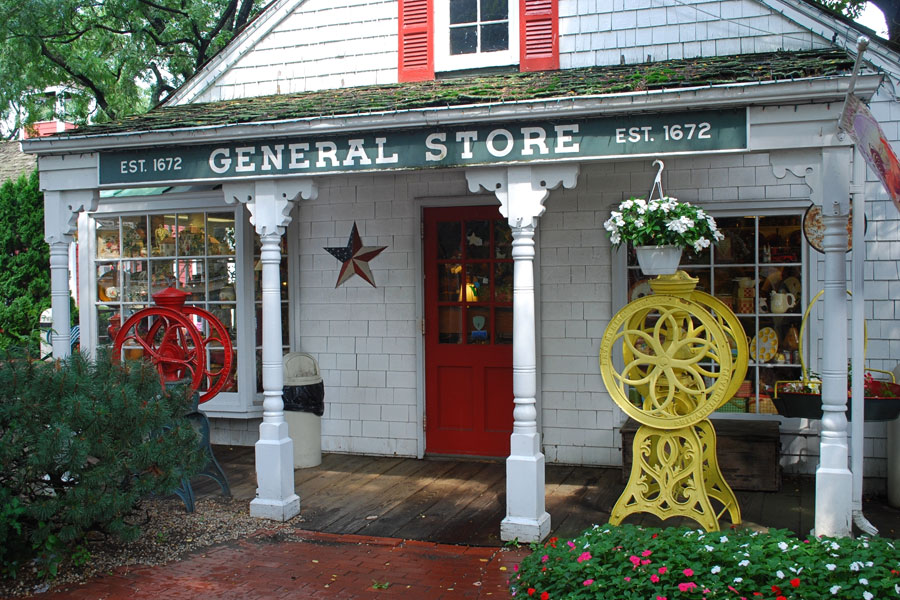
The Milleridge area is one of the most recognizable reminders of Jericho’s historic character. Its collection of colonial-style buildings, dining establishments, shops and seasonal displays has long provided a visual connection with the community’s earlier appearance and has become a familiar local landmark along Jericho Turnpike.
The history associated with the property reaches into Jericho’s colonial period, although the complex visitors recognize today has evolved considerably over time. Its continued presence along a heavily developed suburban corridor creates a striking contrast between the appearance of old Jericho and the commercial landscape that surrounds it.
From Farms to Suburbia
For much of its early history, Jericho was an agricultural community characterized by farms, scattered homes and institutions associated with the Quaker population. That landscape gradually changed as transportation improved and development spread eastward from New York City.
The transformation accelerated during the 20th century as Nassau County became one of the country’s most prominent suburban areas. Former farmland was subdivided for residential development, new schools were constructed and automobile-oriented shopping and office development appeared along major roads. Jericho ultimately became part of the densely interconnected suburban landscape of central Nassau County while retaining several historic sites from its much earlier rural period.
Geography and Location
Jericho occupies a central location in northern Nassau County, inland from the communities along Long Island’s North Shore. The Census Bureau defines the Jericho CDP as approximately 3.96 square miles of land. Its location provides relatively short connections to both the North Shore and the larger commercial and transportation corridors running through central Nassau County.
Nearby communities include Syosset to the east, Hicksville to the south, Westbury and Old Westbury to the west, and Muttontown and other North Shore communities to the north. These boundaries place Jericho between some of Nassau County’s major suburban business districts and the lower-density estate communities closer to the North Shore.
Residential Character
Modern Jericho is primarily residential away from its major commercial corridors. Neighborhoods include a mixture of single-family homes developed during different periods of Nassau County’s suburban expansion, along with condominium and other residential communities. Mature landscaping and winding neighborhood streets contrast with the busier environment along Jericho Turnpike and nearby arterial roads.
Jericho’s location, school district and proximity to major employment centers have made the community a longstanding choice for commuters and families. Unlike an incorporated village, however, Jericho does not have its own village government. Most of the hamlet is governed as part of the Town of Oyster Bay, while the Census Bureau separately defines Jericho as a census-designated place for statistical purposes.
Schools and Education
Education is one of the most prominent parts of Jericho’s modern identity. The Jericho Union Free School District operates three elementary schools, a middle school and Jericho High School. The elementary schools are Cantiague Elementary School, George A. Jackson Elementary School and Jeffrey Ratner Robert Seaman Elementary School.
Jericho Middle School and Jericho High School serve older students from a shared educational campus. The district provides academic, arts, athletic and extracurricular programs and has become one of the institutions most closely identified with the community.
The importance of education in Jericho also has deep historical roots. The Friends schoolhouse associated with the Jericho Friends Meeting House dates to 1793, providing a physical reminder that formal education was part of community life long before the establishment of today’s suburban school system.
Transportation and Getting Around
Jericho’s central Nassau County location provides access to several of Long Island’s principal highways. The Long Island Expressway runs near the community, while the Northern State Parkway provides another major east-west route. Jericho Turnpike remains the area’s major surface-road corridor and carries both local and regional traffic.
Jericho does not have a Long Island Rail Road station within the hamlet. Residents and visitors commonly use nearby stations in Hicksville or Syosset, depending on destination, service and parking needs. The Hicksville station is a major LIRR hub, while Syosset provides convenient rail access for many communities in the surrounding area.
Shopping, Dining and Commerce
Commercial activity is concentrated primarily along Jericho Turnpike and other major roads rather than in a traditional walkable downtown. Restaurants, professional offices, retail businesses and service establishments line portions of the corridor, with additional commercial districts immediately beyond Jericho in Hicksville, Syosset and Westbury.
This pattern reflects Jericho’s evolution from an agricultural crossroads into an automobile-oriented suburb. The historic road remains important, but its modern function is very different from the route traveled by farmers, wagons and long-distance travelers during earlier centuries.
Parks, Recreation and Nearby Attractions
Jericho’s central location places residents and visitors within easy reach of recreational and cultural destinations across northern Nassau County. Nearby Cantiague Park provides facilities for sports and seasonal recreation, while Stillwell Woods Preserve offers trails and wooded open space in the neighboring Syosset area.
The hamlet is also convenient to two major cultural attractions: Old Westbury Gardens and the Nassau County Museum of Art. The surrounding North Shore region adds historic estates, museums, preserves, waterfront communities and other destinations within a relatively short drive.
Jericho Today
Jericho today bears little physical resemblance to the sparsely settled farming community established centuries ago, yet pieces of that earlier landscape remain visible. The Friends Meeting House, historic cemetery, old road alignments and the Milleridge area coexist with schools, residential subdivisions, office properties and heavily traveled highways.
That combination gives Jericho an unusually long historical timeline for a modern Nassau County suburb. Its story stretches from 17th-century settlement and Quaker farming through the Revolutionary period, the development of regional roads, the growth of public education and the enormous suburban expansion that reshaped central Long Island during the 20th century.
Jericho, New York
Key Facts and Details
| Fact | Details |
|---|---|
| Community | Jericho, New York |
| Community Type | Hamlet and census-designated place (CDP) |
| Primary Municipality | Town of Oyster Bay |
| County | Nassau County |
| State | New York |
| Region | Central and northern Long Island |
| 2020 Census Population | 14,808 |
| 2010 Census Population | 13,567 |
| Land Area | Approximately 3.96 square miles |
| 2020 Population Density | Approximately 3,737.5 residents per square mile |
| ZIP Code | 11753 |
| Early Settlement | Area associated with the Robert Williams Plantation by 1648 |
| Early Name | Lusum; historical records also contain references to The Farms and Springfield |
| Jericho Name | Adopted in 1692 and derived from the biblical city of Jericho |
| Historic Religious Community | Quakers, formally known as the Religious Society of Friends |
| Major Historic Landmark | Jericho Friends Meeting House Complex, 6 Old Jericho Turnpike |
| Meeting House | Built in 1788 |
| Historic Schoolhouse | Friends schoolhouse dating to 1793 |
| National Register | Jericho Friends Meeting House Complex added to the National Register of Historic Places in 2002 |
| Notable Historic Figure | Elias Hicks, influential Quaker preacher who lived in Jericho and was associated with the Friends Meeting House |
| Historic Economy | Originally dominated by farming and activities associated with an inland agricultural community |
| Modern Character | Primarily residential suburban community with commercial and office development along major roads |
| School District | Jericho Union Free School District |
| District Schools | Three elementary schools, Jericho Middle School and Jericho High School |
| Elementary Schools | Cantiague Elementary, George A. Jackson Elementary and Jeffrey Ratner Robert Seaman Elementary |
| Major Road | Jericho Turnpike |
| Highway Access | Long Island Expressway and Northern State Parkway |
| LIRR Access | No station within Jericho; nearby Hicksville and Syosset stations provide Long Island Rail Road service |
| Recognizable Landmark | The historic Milleridge area along Jericho Turnpike |
| Nearby Communities | Syosset, Hicksville, Old Westbury, Westbury and Muttontown |
| Nearby Attractions | Old Westbury Gardens, Nassau County Museum of Art, Cantiague Park and Stillwell Woods Preserve |
| Known For | Quaker history, Jericho Friends Meeting House, Jericho schools, suburban neighborhoods and central Nassau County location |
Jericho’s identity is shaped by an unusual combination of deep history and modern suburban development. The community that began as a small agricultural settlement associated with Quaker families now sits amid some of Nassau County’s busiest transportation and commercial corridors, yet landmarks such as the 1788 Friends Meeting House continue to preserve tangible evidence of its earliest generations. With a 2020 population of 14,808, a prominent public school system, direct access to major highways and a location near communities and attractions across northern Nassau County, Jericho has evolved far beyond its farming origins while retaining a historical identity that reaches back more than three centuries. That continuity, from the old Quaker settlement and Jericho Turnpike to today’s residential neighborhoods and schools, makes Jericho one of the more historically layered suburban communities on Long Island.
Are you ready for fall on Long Island? Check out these local seasonal guides:
🍎 Apple Picking | 🍂 Fall Festivals & Farm Activities | 👻 Haunted Houses | 🎃 Pumpkin Picking