

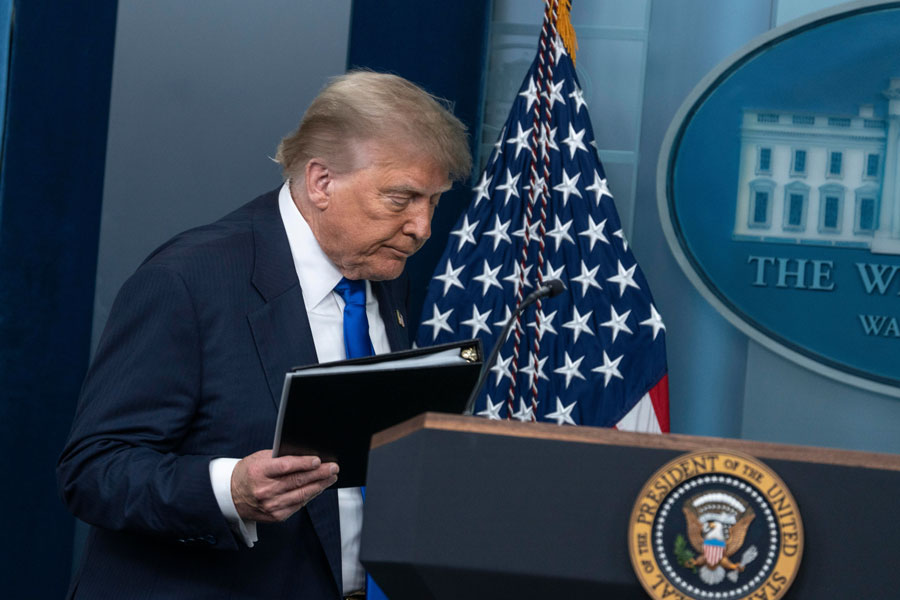
WASHINGTON, DC – The White House has released a new set of declassified intelligence and investigative materials that President Donald Trump says expose previously undisclosed vulnerabilities in U.S. election systems, foreign acquisition of voter data, and evidence of voter-registration fraud that was not fully pursued.
Released following the president’s July 16 address, the material is now collected on a White House election-integrity page and includes documents concerning election-system security, China’s acquisition of U.S. voter information, a Michigan voter-registration investigation, and alleged noncitizen registrations.
The disclosures do not constitute a formal finding that foreign actors changed vote totals or altered the outcome of the 2020 presidential election. They do, however, present new material that raises significant questions about what intelligence agencies knew, what was communicated to the president and the public, and whether certain alleged election-related crimes were investigated with sufficient urgency.
Intelligence Warning: Foreign Actors Had the Capability to Compromise Election Infrastructure
Among the released intelligence assessments is a warning that Russia, China, Iran, North Korea, and non-state actors had the capability to compromise U.S. election infrastructure.
The assessment identified centralized election-related systems, including voter-registration databases, electronic pollbooks, and official election websites, as particularly vulnerable to exploitation. Such access could be used to disrupt election processes, steal sensitive data, spread disinformation, or target voters and election officials.
The newly public material places renewed attention on the difference between a known vulnerability and proof of a successful attack. The documents establish that intelligence agencies had identified substantial risks before the 2020 election. They do not, by themselves, establish that a foreign government successfully changed U.S. vote totals.
Newly Released Email Says Election References Were Kept Out of a Pending Presidential Brief
One of the most notable documents is a November 2020 email from an intelligence analyst involved in China and North Korea strategic assessments.
In the email, the analyst wrote that officials had “deliberately massaged” a pending President’s Daily Brief “to avoid any direct links to the election.” The email also stated that a larger report had been divided into 13 separate reports, with material potentially cross-posted or downgraded for incorporation into a 45-day assessment.
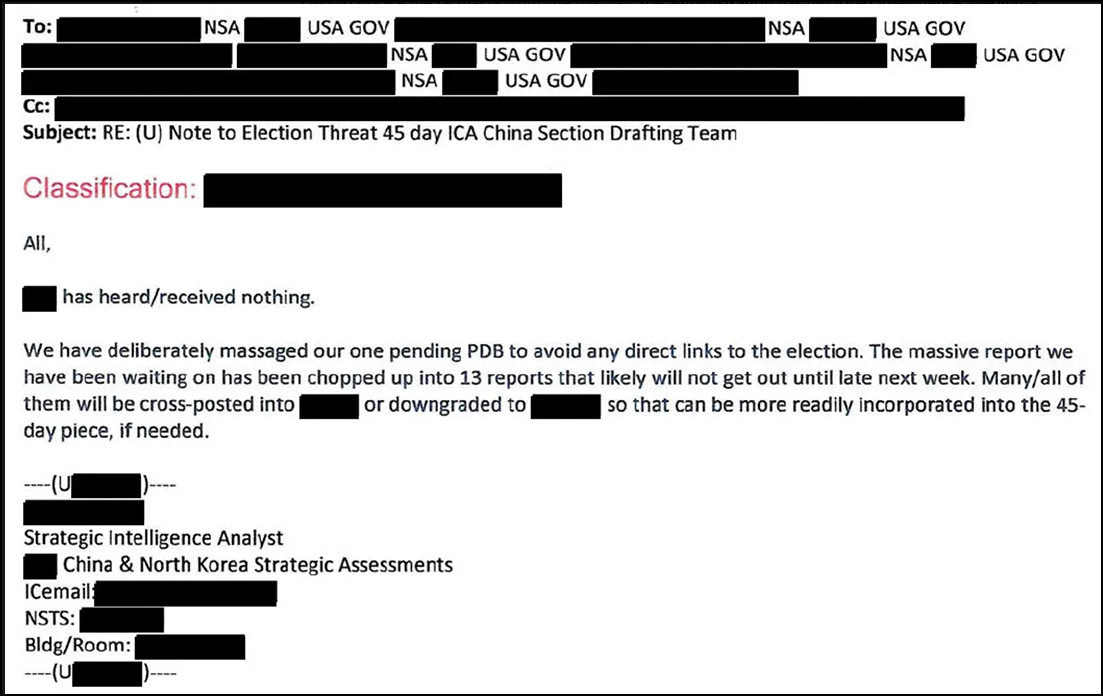
That email provides direct evidence that election-related intelligence was being handled in a way that avoided direct inclusion in at least one pending presidential briefing. It does not identify all officials involved, establish who ordered the decision, or show the full scope of similar conduct throughout the intelligence community. But it is likely to fuel further scrutiny of how foreign-election intelligence was presented to the president in the weeks after the 2020 election.
White House Says China Acquired Voter Files Covering 220 Million Americans
The White House also alleges that China acquired voter information covering approximately 220 million Americans over several years beginning during the 2020 election cycle.
According to the White House, the information included names, home addresses, phone numbers, and political-party preferences, and intelligence indicated China created a data-exploitation unit associated with the effort. The administration says U.S. agencies began learning in 2020 that voter data from at least 18 states had been bought, stolen, or hacked by China, but the information was not adequately disclosed to the president, Congress, or the public.
Even where voter-registration data is publicly obtainable or commercially available in some states, mass collection by a foreign government can present substantial security concerns. Such information can be used for targeted phishing attacks, impersonation, voter intimidation, political profiling, disinformation campaigns, and attempts to exploit weak points in election-administration systems.
The new disclosure is particularly notable in light of the Justice Department’s prior response to Iranian interference in the 2020 election. In 2021, DOJ charged two Iranian nationals accused of exploiting a state election website, obtaining data on more than 100,000 voters, sending threatening messages to voters, and spreading election-related disinformation. The comparison raises an obvious question: if China’s alleged acquisition was far broader, why was it not publicly addressed with comparable urgency?
Michigan Case Raises Questions About Fraudulent Registration Applications
The released materials also concern an investigation in Muskegon, Michigan, involving suspicious voter-registration applications submitted before the 2020 election.
According to the White House and reporting on the newly released FBI records, investigators identified applications with nonexistent addresses, invalid phone numbers, signatures that did not match state records, and patterns suggesting forms had been completed in the same handwriting. Investigators reportedly estimated that approximately 8,000 to 10,000 applications may have been involved.
Former workers interviewed by investigators allegedly said some canvassers were paid based on the number of applications submitted and were instructed to complete applications if they could not obtain enough legitimate ones. One FBI communication cited in the released material indicates that DOJ leadership directed that no further action be taken at one point in 2021. An FBI agent later questioned the limited scope authorized for the investigation.
The case is important because it concerns alleged fraud in the voter-registration process, not merely a dispute over election procedures. At the same time, Michigan State Police previously said the suspect registrations were identified, voided, and did not result in absentee ballots being issued. The currently released material does not establish that fraudulent ballots were cast or counted from those applications.
That distinction does not eliminate the seriousness of the alleged conduct. Fraudulent registration applications can overwhelm local election offices, create confusion, undermine public confidence, and create opportunities for further abuse. The unresolved question is whether the investigation was unnecessarily narrowed or prematurely closed, and whether those responsible will now face charges.
Mail-In Voting Debate Returns
The disclosures have also revived debate about mail-in voting and ballot security.
A 2023 Heartland Institute/Rasmussen Reports poll found that one in five respondents who said they voted by mail in 2020 reported at least one form of conduct the poll sponsor characterized as voter fraud, including filling out a ballot for a friend or family member, voting in a state where they were no longer a permanent resident, or signing a ballot or envelope for another person.
The results raise concerns that warrant closer examination, especially given the unprecedented scale of mail voting in 2020. However, the poll is not an audit of ballots or voter records, and some of the conduct referenced can be lawful in limited circumstances, including assistance provided to voters with disabilities. It therefore cannot, on its own, establish how many illegal ballots were cast or counted.
What the New Release Establishes and What It Does Not
The White House documents establish that U.S. intelligence agencies recognized foreign threats to election infrastructure, that foreign acquisition of voter information was a serious concern, and that at least one intelligence analyst described efforts to keep direct election references out of a pending presidential briefing.
They also bring renewed attention to the Muskegon voter-registration investigation and the question of whether investigators were prevented from fully pursuing potential criminal violations.
What the public record does not yet establish is that foreign actors changed the outcome of the 2020 election, or that fraudulent registration applications in Michigan resulted in fraudulent votes being counted.
That is not the end of the matter. President Trump has directed the FBI, CIA, Department of Justice, and Office of the Director of National Intelligence to investigate how the intelligence was handled and whether any laws were broken. As additional records are released and investigators review the newly public material, the questions raised by the disclosures are likely to remain central to the national debate over election security.
Are you ready for fall on Long Island? Check out these local seasonal guides:
🍎 Apple Picking | 🍂 Fall Festivals & Farm Activities | 👻 Haunted Houses | 🎃 Pumpkin Picking