
Hewlett House, Hewlett, New York
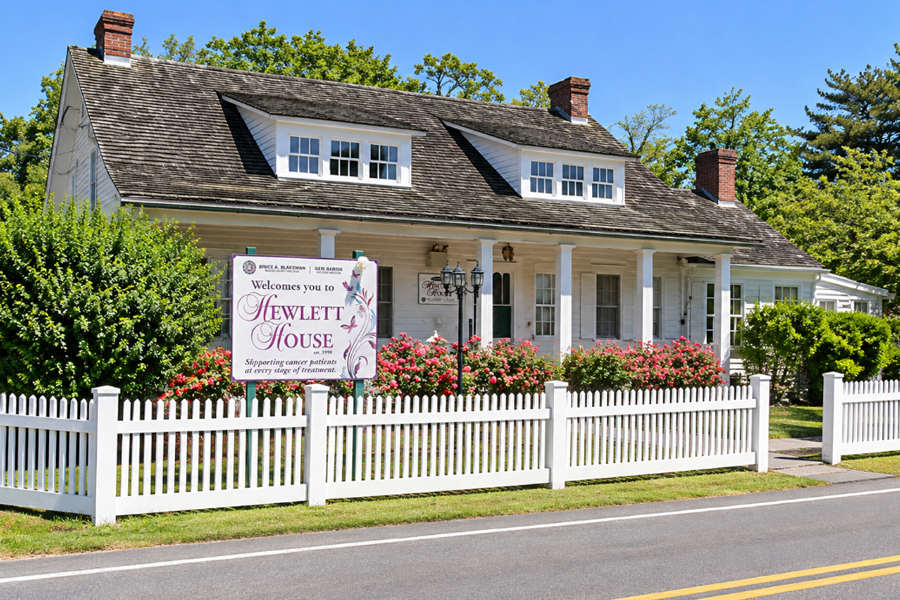
Hewlett House, also known as the Hewlett Homestead, is a historic colonial-era residence located at 86 East Rockaway Road in Hewlett, Nassau County, on Long Island. Dating to approximately 1740, the building is among the surviving examples of early Dutch-influenced residential architecture in the region. Recognized as a historic landmark by the Town of Hempstead, the property provides an important connection to the agricultural settlement and early families of southwestern Long Island.
The house is particularly significant because it remains on its original site, preserving a physical connection to the community’s colonial past. Constructed by descendants of George Hewlett, an early member of the family for which the surrounding community was named, the residence predates the railroad, modern suburban development and the establishment of Nassau County itself.
Unlike many preserved historic residences that operate as public museums, Hewlett House has also served a modern community purpose. Following restoration, the building became associated with One in Nine, a nonprofit organization providing cancer awareness and support services. Its historical importance and later charitable use make it a distinctive landmark within the Five Towns region.
History of Hewlett House
The history of Hewlett House begins with the settlement of the western South Shore during the colonial period. Before European settlement, the surrounding area formed part of the traditional homeland of Indigenous communities, including peoples associated with the Rockaway region. During the 17th and 18th centuries, European settlers established farms, homesteads and small communities within the territory that became the Town of Hempstead.
George Hewlett was among the early members of the Hewlett family on Long Island. His descendants acquired and maintained agricultural properties in the area, establishing a family presence that would continue for generations. The community of Hewlett eventually took its name from this family.
According to the Town of Hempstead’s historical account, Hewlett House was built around 1740 by descendants of George Hewlett. At the time, the surrounding landscape was predominantly rural, consisting of farms, woodlands, meadows and roads connecting scattered settlements.
The property would have existed during the decades preceding the American Revolution, when Long Island remained part of colonial New York. It also survived the British occupation of Long Island during the Revolutionary War and the substantial changes in land use and population that followed American independence.
As the region developed, the house remained associated with the Hewlett family’s historical presence. Its survival is especially notable because much of southwestern Nassau County’s original agricultural landscape disappeared during the 19th and 20th centuries as railroad expansion and suburban development transformed the area.
Dutch Colonial Architecture
One of the principal reasons Hewlett House is historically significant is its architecture. The Town of Hempstead identifies the residence as an example of early Dutch colonial influence, a building tradition associated with some of the earliest European settlements in New York and Long Island.
Dutch-influenced colonial houses often incorporated practical construction methods adapted to local materials, climate and agricultural life. Their architectural traditions differed in certain respects from the English colonial and later Georgian styles that became common throughout the region.
The Town of Hempstead describes Hewlett House as one of approximately a dozen surviving old Dutch houses on Long Island. That distinction makes the residence an important example of a relatively uncommon architectural tradition, particularly in a heavily developed portion of Nassau County.
Its significance lies not simply in its age, but in the survival of historic building characteristics and its continued presence on the land where it was originally constructed. Together, these features provide evidence of how early Long Island residences were built and how families lived before the development of modern suburban communities.
Historic Preservation and Documentation
Hewlett House has been recognized for its historical and architectural value for many decades. The property was documented in connection with the Historic American Buildings Survey in 1936, a federal program established to record significant examples of American architecture.
The Historic American Buildings Survey was created during the Great Depression and became an important means of documenting structures that might otherwise be altered or lost. Its records frequently include architectural descriptions, measured drawings and photographs that preserve information about historic buildings.
The Town of Hempstead also identifies Hewlett House as possessing National Register of Historic Places significance and includes it among the town’s designated landmarks. This recognition reflects the building’s importance as a surviving example of early residential architecture and its association with one of the region’s founding families.
Preserving a building such as Hewlett House is particularly meaningful in the Five Towns, where commercial and residential development has replaced much of the original farmland. Historic properties provide visible reminders of the communities that existed before the arrival of commuter railroads, suburban subdivisions and modern shopping districts.
The Hewlett Family and the Development of the Five Towns
The Hewlett family’s influence extended beyond the property now known as Hewlett House. Family landholdings and residences were associated with several communities in southwestern Long Island, including the broader area surrounding modern Hewlett, Woodmere and Lawrence.
During the colonial and early national periods, landownership and agriculture were important foundations of local economic life. Families such as the Hewletts maintained farms and estates, while the nearby bays and tidal waterways supported fishing, transportation and other maritime activities.
The arrival of railroad service during the 19th century transformed this landscape. Agricultural properties were increasingly subdivided into residential lots, and communities developed around railroad stations, commercial streets and new transportation routes.
By the early 20th century, Hewlett and neighboring communities had become established suburbs. The broader Five Towns developed into a collection of closely connected but administratively distinct villages and hamlets, including Cedarhurst, Lawrence, Woodmere and Inwood.
Hewlett House survived these changes and remains an important link between the agricultural history of the region and its modern suburban identity.
Transfer of Ownership and Restoration
The modern preservation history of Hewlett House began with a significant transfer of ownership in the 1970s. According to the Town of Hempstead, Ceresies Hewlett bequeathed the homestead to the Hewlett-Woodmere School District in 1974.
This transfer helped move the property from its longstanding family association toward institutional stewardship. During the late 1990s, the school district sold the house to Nassau County, placing it under public ownership.
The building subsequently underwent restoration, preserving its historic character while allowing it to accommodate a new community use. This transition illustrates one approach to historic preservation: maintaining an important building through an active purpose rather than leaving it vacant or converting it entirely into a museum.
The Town of Hempstead continues to recognize Hewlett House as an important local landmark, and its preservation provides an example of how historic properties can remain relevant long after their original residential use has ended.
Hewlett House as a Community Support Center
Following its restoration, Hewlett House became associated with One in Nine, also known as the Long Island Breast Cancer Action Coalition, a nonprofit organization involved in cancer awareness and support services.
Community resource listings have described the facility as providing support groups, counseling, wellness programs and practical resources for people affected by cancer. Services historically associated with the center have included educational programming, assistance with wigs and other personal care needs, and opportunities for emotional support.
This use gave the historic residence an additional role in community life, connecting its preservation with a charitable purpose. The building’s residential setting also offered an alternative to the institutional atmosphere often associated with medical and support facilities.
Because nonprofit operations, programs and availability can change, anyone seeking assistance or wishing to visit the facility should confirm its current operating arrangements directly rather than relying on historical descriptions of its services.
Hewlett House and Other Historic Homes in the Area
Hewlett House is part of a broader architectural history that includes other surviving colonial and early American buildings throughout southwestern Nassau County.
One notable example is Rock Hall in nearby Lawrence. Built in 1767 for Josiah Martin, Rock Hall later became associated with the Hewlett family and was eventually donated to the Town of Hempstead. Unlike Hewlett House, Rock Hall operates as a historic house museum offering educational programs and guided tours by appointment.
Although both properties have connections to the Hewlett family, they are separate historic buildings with different origins, architectural styles and present-day uses. Hewlett House is associated with early Dutch colonial traditions, while Rock Hall is an example of Georgian-style architecture.
Another distinction is important for historical research: the Oliver Hewlett House documented by the Library of Congress in East Rockaway is a different historic property. It should not be confused with the Hewlett Homestead at 86 East Rockaway Road in Hewlett.
Together, these surviving residences provide insight into the early settlement, architectural development and family histories of Long Island’s western South Shore.
Location and Visiting Information
Hewlett House is located at 86 East Rockaway Road in Hewlett, within the Town of Hempstead. The property is situated in an established residential area of southwestern Nassau County.
Visitors traveling by car can reach the surrounding area using Peninsula Boulevard, Broadway and nearby Sunrise Highway. The Hewlett station on the Far Rockaway Branch of the Long Island Rail Road provides regional rail service, although travelers should plan their onward transportation to the property.
Hewlett House should not be treated as a regularly operating tourist attraction. Public tour hours, museum admissions and routine walk-in access are not established in the Town of Hempstead’s landmark description. Visitors should respect the property’s current use, avoid entering without authorization and confirm any appointment or event arrangements in advance.
Those interested in historic house tours in the surrounding region may wish to explore Rock Hall Museum in Lawrence, which has an established public interpretation program. For broader community information, Long Island Guide also maintains destination pages covering Hewlett and the Five Towns.
Hewlett House, Hewlett, New York
Key Facts and Details
| Historic Landmark | Hewlett House |
| Alternative Name | Hewlett Homestead |
| Address | 86 East Rockaway Road, Hewlett, NY 11557 |
| Community | Hewlett |
| Town | Town of Hempstead |
| County | Nassau County |
| Region | Five Towns, southwestern Long Island |
| Property Type | Historic colonial-era residence and community-use property |
| Approximate Construction Date | 1740 |
| Original Builders | Descendants of George Hewlett |
| Architectural Significance | Surviving Dutch colonial-influenced residential architecture |
| Original Location | Building remains on its original site |
| Historic Family Association | Hewlett family, early landowners in southwestern Long Island |
| Historic Documentation | Historic American Buildings Survey, 1936 |
| Historic Recognition | Town of Hempstead designated landmark; identified by the town as having National Register significance |
| 1974 Transfer | Bequeathed by Ceresies Hewlett to the Hewlett-Woodmere School District |
| Later Ownership | Sold by the school district to Nassau County in the late 1990s |
| Preservation | Restored following transfer to public ownership |
| Documented Community Use | Associated with One in Nine, a nonprofit cancer awareness and support organization |
| Public Museum | No established regular historic house museum program |
| Public Tours | Not confirmed; visitors should inquire before planning a visit |
| Nearest Railroad Service | Hewlett station, Long Island Rail Road Far Rockaway Branch |
| Nearby Historic Destination | Rock Hall Museum in Lawrence |
| Official Historical Reference | Town of Hempstead Hewlett House landmark information |
Hewlett House stands as an important reminder of the early settlement and architectural history of southwestern Nassau County. Constructed around 1740 by descendants of George Hewlett, the homestead preserves a rare example of Dutch colonial-influenced architecture on its original site, offering a tangible connection to the agricultural community that existed long before modern Hewlett developed. Its documentation through the Historic American Buildings Survey, recognition by the Town of Hempstead, preservation under public ownership and later use as a community support facility illustrate the building’s historical and continuing significance. Although it is not a conventional public museum, Hewlett House remains an important landmark within the Five Towns and a valuable surviving connection to the colonial heritage of Long Island.
Are you ready for fall on Long Island? Check out these local seasonal guides:
🍎 Apple Picking | 🍂 Fall Festivals & Farm Activities | 👻 Haunted Houses | 🎃 Pumpkin Picking