
Race Rock Lighthouse
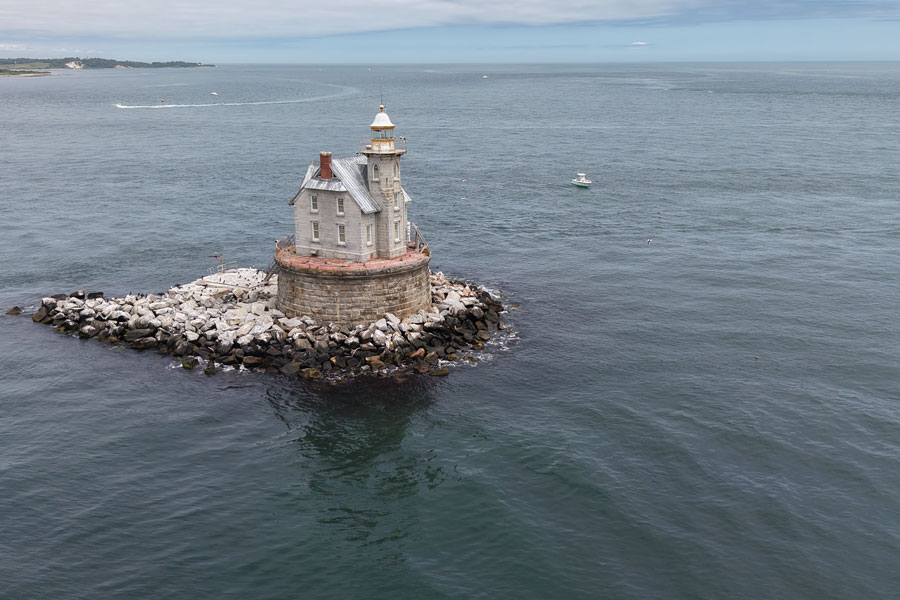
Race Rock Lighthouse stands on a mostly submerged reef in Long Island Sound, approximately three-quarters of a mile southwest of Fishers Island in Suffolk County. The lighthouse marks the western side of The Race, a dangerous passage where powerful tidal currents move between Long Island Sound, Fishers Island Sound and Block Island Sound.
The station was established because Race Rock Reef had become a serious hazard to navigation. By 1837, at least eight vessels had been lost near the reef in an eight-year period. After decades of unsuccessful efforts to mark the obstruction with buoys and temporary structures, construction of the present lighthouse began in 1871 and was completed in 1878. The light was first displayed in 1879.
A Lighthouse Built on a Submerged Reef
Race Rock Lighthouse was one of the most demanding lighthouse construction projects undertaken in the United States during the nineteenth century. Engineers first had to create a stable foundation on a reef that was largely underwater and exposed to strong currents, heavy seas and winter ice.
Thousands of tons of granite and riprap were used to build up the reef and form a massive circular concrete foundation. The foundation supports a granite pier containing cellars and water cisterns, along with a granite keeper’s dwelling and attached light tower.
Design and Construction
The lighthouse was designed by F. Hopkinson Smith, an engineer who later became known for his writing and paintings. The tower is square at its base and octagonal above, with a white lantern rising above the natural-colored granite structure. The design combines practical engineering with the Gothic Revival architectural character common to several major nineteenth-century lighthouses.
The project took approximately seven years to complete. Once the foundation had been secured, the keeper’s dwelling and tower were constructed comparatively quickly, but the overall cost eventually reached approximately $278,716, a substantial amount for the period.
Keepers and Life at Race Rock
Lighthouse keepers and their families lived at Race Rock and maintained the light, buildings and surrounding grounds. Life at the station was isolated and dangerous, with keepers dependent on boats for transportation and supplies. Strong currents and sudden storms could make travel between the lighthouse, Fishers Island and the mainland extremely difficult.
The station’s history also reflects the risks faced by the people who operated offshore lighthouses. Keeper Thomas A. Carroll disappeared in 1885 after attempting to row back to Race Rock during a severe storm. The incident remains one of the most tragic episodes associated with the lighthouse.
Automation and Preservation
The United States Coast Guard automated Race Rock Lighthouse in 1978, ending the need for a resident keeper. The lighthouse remains an operational aid to navigation, and the Coast Guard continues to maintain its lighting equipment.
Race Rock Light Station was listed on the National Register of Historic Places in 2005. In 2013, ownership of the historic property was transferred from the federal government to the New London Maritime Society through the National Historic Lighthouse Preservation Act. The society is responsible for stewardship and preservation, while the Coast Guard continues to operate the navigational light.
Can the Public Visit Race Rock Lighthouse?
Race Rock Lighthouse is not open for ordinary public visits. The structure stands offshore on a hazardous reef, and landing there requires authorization from the property owner. Visitors should not attempt to approach or land at the lighthouse independently because of the powerful currents, exposed rocks, changing weather and boat-landing dangers.
The lighthouse can be viewed from boats traveling near Fishers Island and The Race. Boaters should exercise extreme caution in the area and consult current marine conditions before navigating near the reef.
Race Rock and Long Island’s Eastern Waters
Race Rock Lighthouse is part of the network of historic navigation landmarks surrounding the eastern end of Long Island Sound. Nearby lights include Little Gull Island Lighthouse, Plum Island Lighthouse and Orient Point Lighthouse.
Although Race Rock cannot be visited like a conventional historic attraction, its location and engineering make it one of the most remarkable lighthouses associated with Long Island. The granite station continues to mark a dangerous passage used by commercial vessels, ferries, fishing boats and recreational boaters entering and leaving Long Island Sound.
Race Rock Lighthouse
Key Facts & Details
| Feature | Details |
|---|---|
| Official name | Race Rock Light |
| Common name | Race Rock Lighthouse |
| Type | Active historic lighthouse and navigational aid |
| Location | Race Rock Reef, approximately three-quarters of a mile southwest of Fishers Island |
| County | Suffolk County |
| Nearby community | Fishers Island |
| Waterway | Long Island Sound |
| Navigation passage | The Race |
| Station established | 1879 |
| Construction period | 1871–1878 |
| Architect and engineer | F. Hopkinson Smith |
| Construction materials | Granite, concrete caisson, masonry pier and riprap |
| Tower shape | Square base with an octagonal upper tower |
| Tower height | Approximately 45 feet above the reef |
| Focal-plane height | Approximately 67 feet above the water |
| Original lens | Fourth-order Fresnel lens |
| Light characteristic | Flashing red light |
| Nominal range | Approximately 16 nautical miles |
| Automated | 1978 |
| Current status | Operational navigational aid maintained by the United States Coast Guard |
| Current owner | New London Maritime Society |
| Historic designation | Listed on the National Register of Historic Places in 2005 |
| Public access | Not open for ordinary public visits; authorization is required to land |
| Coordinates | 41.243435, -72.047119 |
| Official historical source | U.S. Coast Guard Historian’s Office |
| Long Island Lighthouses | How many lighthouses are on Long Island? |
Race Rock Lighthouse remains one of the most impressive offshore navigation structures associated with Long Island. Built on a dangerous reef between Fishers Island and Connecticut, the granite station has guided vessels through The Race and the eastern entrance to Long Island Sound for more than a century. Although the lighthouse is not open for ordinary public visits, its engineering, history and continuing navigational role make it an important part of Suffolk County’s maritime heritage. Viewed from the surrounding waters, Race Rock remains a powerful reminder of the dangers faced by mariners and lighthouse keepers along Long Island’s eastern coast.
Are you ready for fall on Long Island? Check out these local seasonal guides:
🍎 Apple Picking 🍓 Strawberry Picking 🎃 Pumpkin Picking 👻 Haunted Houses 🍂 Farm Festivals