
Little Gull Island Lighthouse
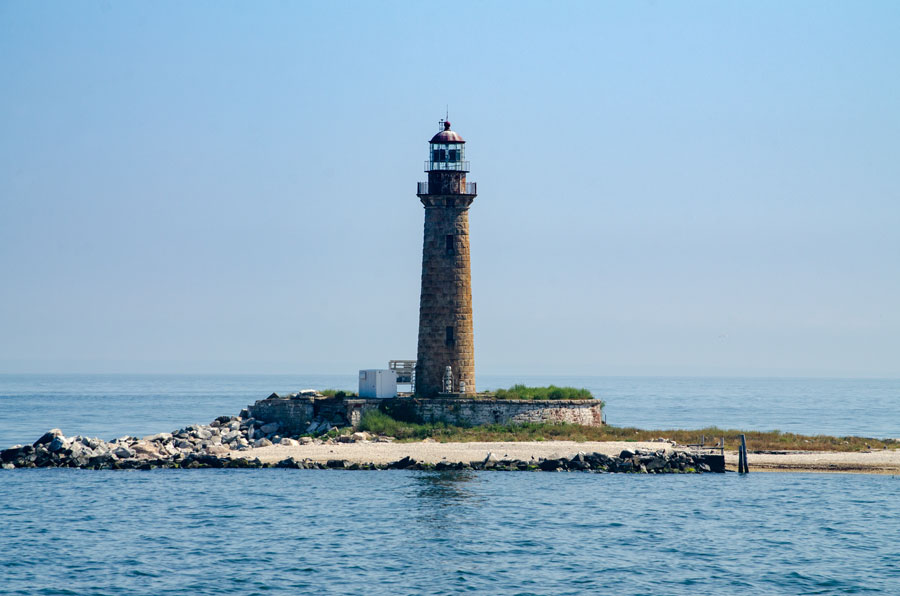
Little Gull Island Lighthouse stands on a tiny rocky island in Long Island Sound, approximately midway between Plum Island and Fishers Island. Located in the eastern waters of Suffolk County, the lighthouse marks the western side of The Race, a narrow passage known for powerful currents at the eastern entrance to Long Island Sound.
The lighthouse station was established in 1806, making Little Gull Island one of the oldest lighthouse sites associated with Long Island. The original tower was replaced by the current granite lighthouse in 1869. The active beacon continues to guide vessels through one of the most heavily traveled and challenging maritime passages in the region.
The First Little Gull Island Lighthouse
Little Gull Island was selected for a lighthouse because of its position near the main entrance to Long Island Sound. The island lies close to The Race, where tidal currents moving between Long Island Sound and the open Atlantic can create difficult conditions for vessels.
The first lighthouse was established in 1806. During the War of 1812, British Royal Marines carried out a raid on the island and extinguished the light. The incident demonstrated the importance of the station to navigation and left vessels without the beacon during a period of military conflict.
Construction of the Present Lighthouse
The original lighthouse was replaced by the present structure in 1869. The current tower is a tall, conical granite structure built on a granite pier. Its natural stone exterior, elevated lantern and exposed position allow the lighthouse to stand out against the surrounding waters of Long Island Sound.
The lighthouse was originally equipped with a second-order Fresnel lens, a powerful optical system designed for stations that needed to project light across long distances. The beacon helped mariners identify Little Gull Island while navigating The Race, Plum Gut and the approaches to Long Island Sound.
Keepers, Fog Signals and Island Life
For generations, lighthouse keepers lived on Little Gull Island and maintained the light, buildings and fog-signal equipment. The isolated station was surrounded by rocky shoreline and exposed to storms, heavy seas and rapidly changing weather conditions.
Hurricanes and severe coastal storms repeatedly damaged the station. A major hurricane in 1938 sent water into the keeper’s quarters, while a fire in 1944 destroyed much of the keeper’s house and spread into the lighthouse tower. The lens survived, but the tower required extensive repairs.
The station also became associated with the challenges of fog navigation. In 1881, the steamship Galatea ran aground near Little Gull Island during dense fog. An investigation examined whether the fog signal had been operating properly and documented the unusual way sound traveled around the island and surrounding waters.
Automation and Modern Ownership
Little Gull Island Lighthouse was automated in 1978, ending the need for a resident keeper. The Coast Guard later removed the replacement keeper’s building in 2002, leaving the historic granite tower standing alone on the old stone foundation.
The lighthouse was declared excess federal property and offered for sale through the National Historic Lighthouse Preservation Act. After a public auction process, the property was purchased by a private owner. The lighthouse remains an active navigational aid, although the island is not operated as a conventional public historic site.
Can the Public Visit Little Gull Island Lighthouse?
Little Gull Island Lighthouse is not open for ordinary public visits. The island is privately owned, remote and surrounded by hazardous waters, and visitors should not attempt to land there without permission from the owner or an authorized tour operator.
The lighthouse may be viewed from boats traveling through the surrounding waters. Boaters should use extreme caution near The Race and the island’s rocky reefs, where strong tidal currents, shoals, fog and changing weather can create dangerous conditions.
Little Gull Island and Long Island’s Eastern Waters
Little Gull Island Lighthouse is part of a network of historic navigation landmarks surrounding the eastern end of Long Island Sound. Nearby lighthouses include Plum Island Lighthouse, Orient Point Lighthouse and the historic lights associated with Fishers Island and the North Fork.
Although the island is too small and isolated for conventional tourism, its lighthouse provides an important connection to the maritime history of Long Island’s North Fork. The structure continues to mark the waters where commercial ships, ferries, fishing boats and recreational vessels enter and leave Long Island Sound.
Little Gull Island Lighthouse
Key Facts & Details
| Feature | Details |
|---|---|
| Official name | Little Gull Island Light |
| Common name | Little Gull Island Lighthouse |
| Type | Active historic lighthouse and navigational aid |
| Location | Little Gull Island in Long Island Sound, off Fishers Island and the North Fork |
| County | Suffolk County |
| Nearby community | Orient |
| Waterway | Long Island Sound |
| Navigation passage | The Race, between Little Gull Island and Fishers Island |
| Island size | Approximately one acre above high water |
| Station established | 1806 |
| Original tower | Approximately 51-foot lighthouse established in 1806 |
| Current tower completed | 1869 |
| Construction materials | Granite tower on a granite pier |
| Tower shape | Conical |
| Tower height | Approximately 81 feet |
| Focal-plane height | Approximately 91 feet above mean high water |
| Original lens | Second-order Fresnel lens installed in 1869 |
| Light characteristic | Two white flashes every 15 seconds |
| Nominal range | Approximately 18 nautical miles |
| Fog signal | One blast every 15 seconds, where applicable |
| Automated | 1978 |
| Deactivated | Not deactivated; remains operational |
| Keeper’s house | Damaged by fire in 1944 and later removed in 2002 |
| Ownership | Privately owned after federal surplus-property auction |
| Public access | Not open for ordinary public access; permission is required to land on the island |
| Coordinates | 41.206111, -72.106694 |
| Official historical source | U.S. Coast Guard Historian’s Office |
| Long Island Lighthouses | How many lighthouses are on Long Island? |
Little Gull Island Lighthouse remains one of the most isolated and historically important lighthouses in the waters surrounding Long Island. Established in 1806 and rebuilt in 1869, the granite tower continues to guide vessels through The Race and the eastern entrance to Long Island Sound. Although the lighthouse cannot ordinarily be visited by the public, it can be viewed from the water and appreciated as part of the maritime landscape surrounding the North Fork, Plum Island and Fishers Island. Its remote location, surviving granite tower and continuing navigational role make Little Gull Island Lighthouse a distinctive part of Suffolk County’s coastal heritage.
Are you ready for fall on Long Island? Check out these local seasonal guides:
🍎 Apple Picking 🍓 Strawberry Picking 🎃 Pumpkin Picking 👻 Haunted Houses 🍂 Farm Festivals