
Execution Rocks Lighthouse
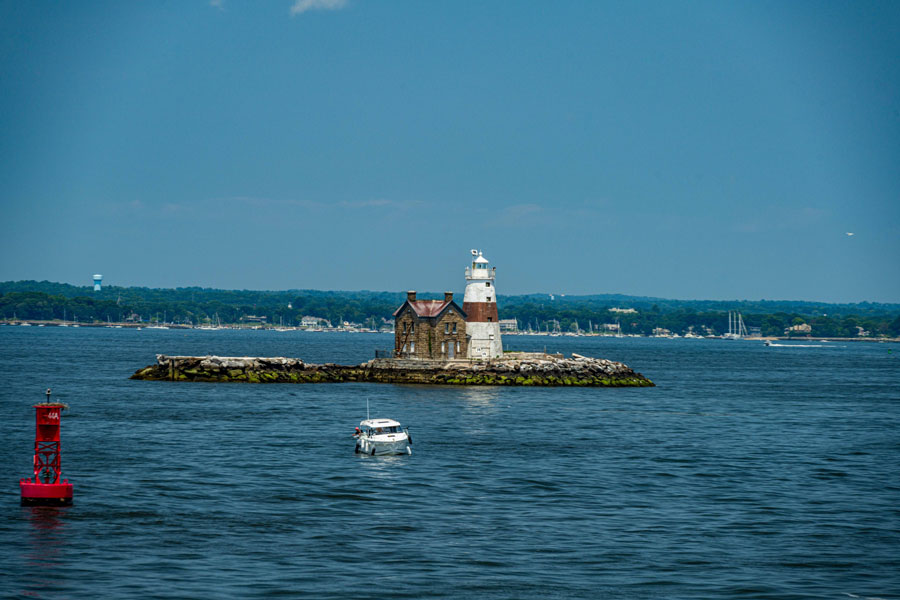
Execution Rocks Lighthouse is a historic offshore lighthouse standing on a rocky reef in the western end of Long Island Sound, approximately one mile from the shoreline between Sands Point and New Rochelle. The active navigational light marks one of the most hazardous areas near the entrance to the East River and helps guide vessels traveling toward New York Harbor.
Completed in 1849 and first lit in 1850, Execution Rocks Lighthouse is one of the most recognizable maritime landmarks in the western Long Island region. Its isolated location, distinctive granite tower and dark historical legends have made it one of the most intriguing lighthouses on Long Island, although access to the island is limited and conditions can change.
A Lighthouse on a Dangerous Reef
The Execution Rocks reef consists of shallow rocks and submerged hazards located in the center of the channel between the North Shore of Long Island and the Westchester County shoreline. Before the lighthouse was built, the reef presented a serious danger to commercial, military and passenger vessels navigating between Long Island Sound, the East River and New York Harbor.
The name Execution Rocks is associated with several historical stories, including an unverified tradition that people were chained to the rocks and left to drown at low tide. Other explanations connect the name with the many ships that were wrecked on the dangerous reef. The lighthouse’s documented purpose, however, was to warn mariners about the rocks and improve navigation through the western Sound.
Construction and Early Operation
In March 1847, the United States Congress appropriated $25,000 for the construction of a lighthouse at Execution Rocks. The station was designed by architect Alexander Parris, and construction was completed in May 1849. The light began operating in 1850.
The conical tower was constructed of granite with a brick lining and placed on a substantial stone and timber foundation. The original tower was approximately 60 feet tall, with its focal plane positioned about 62 feet above the water. A fourth-order Fresnel lens was installed in 1856 to produce a more visible and effective navigational signal.
The Keeper’s Quarters
Execution Rocks Lighthouse originally required resident keepers to maintain the light, operate the station and monitor the surrounding waters. In 1868, attached keeper’s quarters were added, giving the keeper and family more living space than the cramped accommodations inside the tower.
The station survived difficult conditions in the Sound, including storms, heavy seas and a serious fire in December 1918. The fire damaged the tower, oil house, windows, woodwork and other parts of the station, while destroying the engine house and machinery. Repairs allowed the lighthouse to continue serving mariners for many more years.
Automation and Current Navigational Role
Execution Rocks Lighthouse was automated in 1979, ending the era of resident lighthouse keepers. The original Fresnel lens was replaced by a modern lantern, and the United States Coast Guard continues to identify the station as an operational aid to navigation.
The lighthouse displays a flashing white light approximately every 10 seconds. Its white tower with a brown band remains visible from portions of the North Shore, from the water and from elevated locations around western Long Island Sound.
National Register of Historic Places
Execution Rocks Light Station was added to the National Register of Historic Places in 2007. The designation recognizes the lighthouse’s architectural importance, its role in the history of navigation and its connection to the maritime development of Long Island Sound and New York Harbor.
The station is historically significant because it retains the character of a nineteenth-century offshore light station while continuing to function as a navigational landmark. Its remote location also illustrates the difficulty of preserving historic structures exposed to storms, saltwater, erosion and strong tidal currents.
Can the Public Visit Execution Rocks Lighthouse?
Execution Rocks Lighthouse is not a conventional public park and cannot be reached by car or on foot. Public access has historically been restricted, although organized boat tours and special visits have been offered at various times by preservation organizations. Availability, departure locations and permission requirements may change, so visitors should confirm current arrangements before planning a trip.
Boaters may view the lighthouse from the surrounding waters, but the reef contains navigational hazards and strong currents. Anyone approaching the station should follow all Coast Guard regulations, maintain a safe distance from the structure and avoid landing without authorization.
Execution Rocks and the North Shore
Execution Rocks Lighthouse is closely connected to the maritime landscape surrounding Sands Point, Port Washington, Manhasset Bay and the western end of Long Island Sound. The area includes historic estates, waterfront communities, yacht clubs, marinas and former shipping routes that helped shape the history of Nassau County.
The lighthouse can also be viewed in relation to other historic lights in the region, including Sands Point Lighthouse and Stepping Stones Lighthouse. Together, these stations formed part of the network of navigational aids that helped vessels move safely through the crowded and hazardous waters surrounding Long Island and New York Harbor.
Execution Rocks Lighthouse
Key Facts & Details
| Feature | Details |
|---|---|
| Official name | Execution Rocks Light Station |
| Common name | Execution Rocks Lighthouse |
| Type | Active offshore lighthouse and navigational aid |
| Location | Western Long Island Sound, between Sands Point and New Rochelle |
| Nearby Long Island community | Sands Point |
| County association | Nassau County |
| Waterway | Long Island Sound |
| Congressional appropriation | $25,000 approved in March 1847 |
| Construction completed | May 1849 |
| First lit | 1850 |
| Architect | Alexander Parris |
| Tower height | Approximately 60 feet |
| Focal plane | Approximately 62 feet above the water |
| Construction materials | Granite with brick lining on a dressed-stone and timber foundation |
| Tower shape | Conical |
| Daymark | White tower with a brown band around the middle |
| Original lens | Fourth-order Fresnel lens installed in 1856 |
| Keeper’s quarters | Added in 1868 |
| Automation | Automated in 1979 |
| Light characteristic | Flashing white light approximately every 10 seconds |
| Current status | Operational aid to navigation maintained under United States Coast Guard authority |
| Historic designation | Listed on the National Register of Historic Places in 2007 |
| Public access | Restricted offshore site; organized tours or special visits may be available at certain times |
| Related landmarks | Sands Point Lighthouse and Stepping Stones Lighthouse |
| Official historical source | U.S. Coast Guard Historian’s Office |
| Long Island Lighthouses | How many lighthouses are on Long Island? |
Execution Rocks Lighthouse remains one of the most important historic navigational landmarks in western Long Island Sound. Built to warn ships away from a dangerous reef, the 1849 station continues to operate while preserving the history of the keepers, mariners and communities connected to this part of the North Shore.
Although its offshore location limits ordinary public access, Execution Rocks Lighthouse can be viewed from the water and from selected shoreline locations around Sands Point, Port Washington and New Rochelle. Its distinctive tower, difficult setting and long maritime history make it one of the most memorable lighthouses in the Long Island region.
Are you ready for fall on Long Island? Check out these local seasonal guides:
🍎 Apple Picking 🍓 Strawberry Picking 🎃 Pumpkin Picking 👻 Haunted Houses 🍂 Farm Festivals