
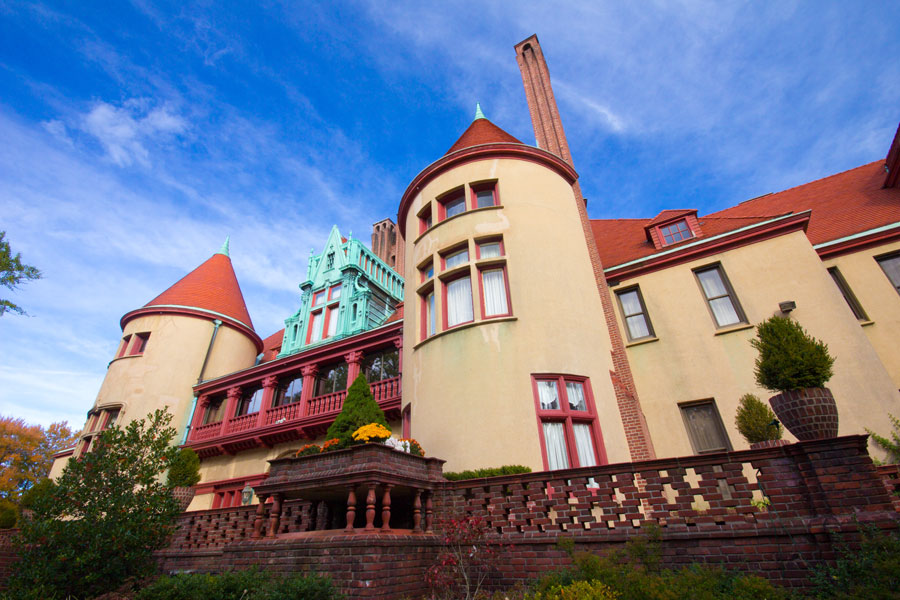
The Gold Coast is the historic estate region of Long Island’s North Shore, known for the grand country homes built by wealthy industrialists, financiers, and other prominent families. Centered in northern Nassau County and extending into western Suffolk County, it is associated with elaborate mansions, landscaped gardens, harbors, and the social world that helped inspire The Great Gatsby.
The name describes a historical and cultural region rather than a municipality or an officially bounded district. Its estate-building era developed during the late nineteenth century and continued into the early twentieth century, including the decades after the Gilded Age. Our Gold Coast mansions guide introduces the surviving properties and their different visitor experiences.
Where Is Long Island’s Gold Coast?
The Gold Coast is generally associated with the northern side of Long Island, around Long Island Sound and its adjoining bays and harbors. Communities commonly connected with its history include Great Neck, Sands Point, Port Washington, Roslyn, Glen Cove, Locust Valley, Oyster Bay, and Huntington.
The term does not mean that every Gold Coast estate stands directly on the shoreline. Some properties occupy inland grounds within the broader North Shore estate landscape. There is also no single agreed boundary separating the Gold Coast from surrounding communities, so maps and descriptions may include somewhat different areas.
Why Is It Called the Gold Coast?
The name refers to the concentration of wealth represented by the region’s estates. Families with fortunes connected to industry, banking, transportation, and commerce commissioned substantial country houses with formal gardens, landscaped grounds, and buildings designed for entertaining and estate life.
These properties were more than oversized houses. An estate could include greenhouses, stables, service buildings, farms, and recreational facilities as well as the main residence. Their operation depended on the work of gardeners, domestic employees, craftspeople, and other staff whose contributions are also part of Gold Coast history.
The architecture drew on several traditions, including English country houses, French châteaux, and Tudor Revival design. The surviving properties reflect different owners, construction periods, and ambitions rather than one uniform architectural style.
Which Gold Coast Estates Can You Explore?
Old Westbury Gardens preserves the former estate of John S. Phipps and his family. Its centerpiece, Westbury House, was completed in 1906. The house, formal gardens, and surrounding landscape offer an introduction to the relationship between a country residence and its carefully planned grounds.
Planting Fields Arboretum State Historic Park, in the Oyster Bay area, preserves the Coe family’s estate landscape. Its historic mansion, gardens, greenhouses, and woodland paths make it a destination for both estate history and horticulture. Mansion tours and access to individual facilities should be checked separately from general grounds admission.
Sands Point Preserve offers another view of the estate era through its historic buildings and grounds in Sands Point. The property includes Hempstead House, Castle Gould, and Falaise, with visitor access differing among buildings, tours, and events.
In Huntington, Coindre Hall illustrates the Gold Coast’s reach into western Suffolk County. The mansion and its setting above Huntington Harbor survive as a county-owned historic property. Consult Suffolk County’s Coindre Hall information for access details rather than assuming the interior operates as a daily walk-in museum.
How Is the Gold Coast Connected to The Great Gatsby?
F. Scott Fitzgerald lived in Great Neck from 1922 to 1924, during the period when he began developing The Great Gatsby. The North Shore’s wealth, social divisions, and estate culture helped inform the novel’s fictional world. Published in 1925, the book remains one of the strongest cultural associations with the Gold Coast.
The novel’s East Egg and West Egg are fictional settings, however, and the story should not be treated as a literal account of one estate or family. Its portrayal of status, inherited wealth, new fortunes, and social aspiration gives the region literary significance beyond its architecture.
What Remains of the Gold Coast Today?
Some estates survive as historic houses and public landscapes, while others have become educational campuses, hospitality properties, event venues, or private residences. Many original properties were demolished, subdivided, or substantially altered. The surviving buildings and grounds therefore represent only part of the estate landscape that once existed.
For visitors, the Gold Coast is a collection of destinations rather than a single attraction. Choose properties based on whether you want historic interiors, gardens, architectural tours, or outdoor walks. Public access to the grounds does not necessarily include admission to a mansion, and a building used for private events may have limited opportunities for general visits.
Key Facts & Details
| Category | Information |
|---|---|
| What It Is | A historic estate region associated with Long Island’s North Shore. |
| General Location | Northern Nassau County and parts of western Suffolk County. |
| Boundaries | Informal; the Gold Coast is not a separate municipality or an officially bounded district. |
| Estate Era | Late nineteenth and early twentieth centuries, extending beyond the Gilded Age into later decades. |
| Name Origin | A reference to the concentration of wealth associated with its grand estates. |
| Representative Communities | Great Neck, Sands Point, Glen Cove, Oyster Bay, and Huntington, among others. |
| Estates to Explore | Old Westbury Gardens, Planting Fields Arboretum State Historic Park, and Sands Point Preserve. |
| Featured Landmark | Coindre Hall, built in 1912 overlooking Huntington Harbor. |
| Literary Connection | F. Scott Fitzgerald’s The Great Gatsby and the author’s years in Great Neck. |
| Visitor Resource | Explore our Gold Coast mansions guide, then confirm each property’s current access and tour arrangements. |
Long Island’s Gold Coast connects grand architecture and designed landscapes with the history of wealth, work, preservation, and American literature. Exploring its surviving estates and surrounding North Shore communities offers a fuller picture of the region than its reputation for luxury alone. Plan around the properties that interest you, checking grounds access, interior tours, and seasonal schedules before visiting.