
Brookhaven National Laboratory
Brookhaven National Laboratory (BNL), located in Upton, New York, within the Town of Brookhaven, is one of the nation’s leading multidisciplinary research institutions. Managed and operated by Brookhaven Science Associates for the U.S. Department of Energy’s Office of Science, the laboratory supports major research programs in physics, chemistry, biology, energy science, environmental science, computing, materials science, and applied technology.
Established in 1947 on the grounds of the former Camp Upton Army installation, Brookhaven has grown into a major international center of scientific research. Its sprawling Suffolk County campus is home to particle accelerators, advanced light sources, nanoscience laboratories, high-performance computing resources, and other specialized facilities used by scientists from across the United States and around the world.
History
Brookhaven National Laboratory was established in the years following World War II, when the federal government and a group of universities sought to create a major scientific center where expensive and sophisticated research facilities could be shared. The site chosen for the laboratory was Camp Upton, a former U.S. Army installation in central Suffolk County that had served military purposes during both World War I and World War II.
The laboratory was founded during the Atomic Energy Commission era and quickly became an important center for nuclear science, accelerator science, and high-energy physics. As scientific priorities changed, Brookhaven expanded into new fields while continuing its work in fundamental physics.
Over the decades, research conducted at Brookhaven has contributed to multiple Nobel Prize-recognized discoveries and significant advances in science and technology. Today, its work extends into clean energy, climate and environmental science, nanotechnology, computing, medical applications, materials research, and other areas of national and international importance.
Research and Major Facilities
Brookhaven National Laboratory is particularly notable for the large-scale scientific facilities located on its campus. These facilities allow researchers to conduct experiments that would be difficult or impossible to perform at conventional university laboratories.
Relativistic Heavy Ion Collider (RHIC): RHIC is a major particle accelerator built to help scientists investigate the fundamental structure and behavior of matter. Researchers use collisions involving atomic nuclei and other particles to study conditions associated with some of the earliest moments of the universe and to better understand the forces governing matter at extremely small scales.
National Synchrotron Light Source II (NSLS-II): NSLS-II produces extremely bright beams of light that scientists use to examine materials at exceptionally small scales. Research conducted at the facility supports work in materials science, chemistry, biology, energy technology, medicine, engineering, and other disciplines.
Center for Functional Nanomaterials (CFN): The Center for Functional Nanomaterials provides specialized equipment and expertise for studying and engineering materials at the nanoscale. Its research supports the development and understanding of new materials with potential applications in energy, electronics, manufacturing, and other technologies.
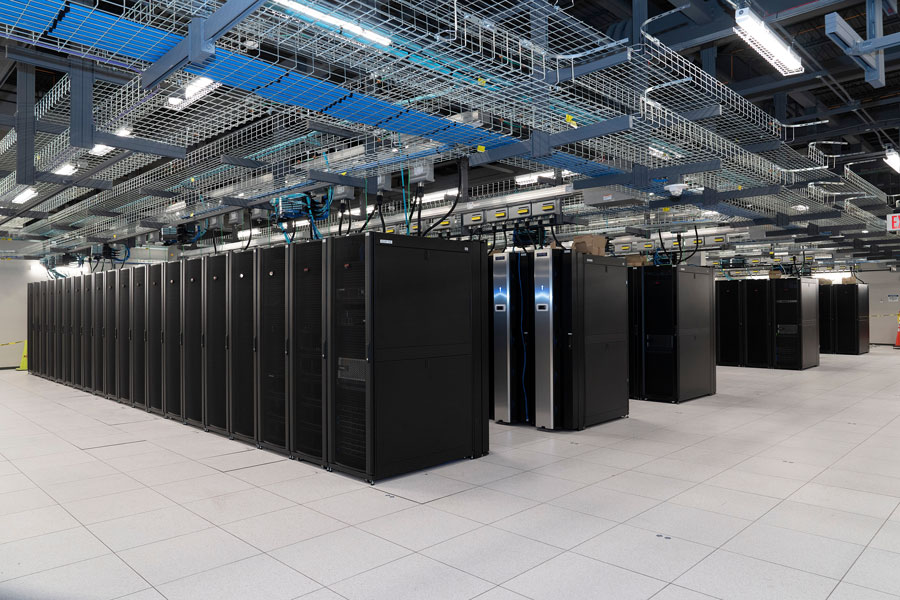
Scientific Data and Computing Center (SDCC): Brookhaven’s computing infrastructure supports the enormous quantities of information produced by modern scientific experiments. The SDCC provides high-performance computing, data storage, processing, and analysis capabilities used by Brookhaven researchers and major scientific collaborations.
Medical and Isotope Research: Brookhaven has a long history of research involving radioactive isotopes and related technologies. This work has contributed to medical imaging, cancer treatment, diagnostic techniques, and other applications connecting fundamental science with healthcare.
Many of Brookhaven’s major facilities operate as national user facilities, allowing qualified researchers from universities, government laboratories, and other institutions to use specialized equipment through scientific proposals and collaborative research programs. The laboratory also works with hospitals, private industry, universities, and other national laboratories to move discoveries from fundamental research toward practical applications.
Science, Technology and Innovation
Although Brookhaven is perhaps best known for particle physics, its scientific mission extends considerably further. Researchers investigate new materials for batteries and energy storage, solar energy technologies, catalysts, biological processes, atmospheric conditions, environmental systems, quantum information science, and advanced computing.
The combination of sophisticated instruments, computing power, engineering expertise, and large multidisciplinary research teams allows the laboratory to address scientific questions across many fields. Discoveries made at Brookhaven can also contribute to technologies and methods later used by universities, medical institutions, government agencies, and private industry.
Education and Scientific Partnerships
Education is another important part of Brookhaven National Laboratory’s role on Long Island. Students, teachers, university researchers, postdoctoral scientists, and visiting scholars participate in research and educational programs connected to the laboratory.
Brookhaven also maintains close relationships with universities and research institutions. Brookhaven Science Associates, which operates the laboratory for the Department of Energy, is associated with Stony Brook University and Battelle. These relationships connect the laboratory with a broader network of academic and scientific expertise.
Impact on Long Island
Brookhaven National Laboratory is one of Suffolk County’s major scientific institutions and employers, supporting thousands of jobs in research, engineering, computing, operations, administration, and technical services. Visiting researchers, contractors, construction projects, scientific collaborations, and educational programs further extend the laboratory’s economic influence throughout the region.
Its presence has also helped establish Long Island as an important center for advanced scientific research. Together with Stony Brook University and other regional institutions, Brookhaven contributes to a concentration of scientific expertise that reaches well beyond the immediate communities surrounding the laboratory.
Visiting Brookhaven National Laboratory
Brookhaven National Laboratory is an active federal research facility rather than a conventional tourist attraction, and access to the campus is controlled. Visitors should not assume they can simply arrive and enter the laboratory grounds for sightseeing.
The laboratory periodically offers public lectures, educational programs, community events, and other opportunities that may allow members of the public to learn about its research. Availability varies, and some programs may require advance registration or have specific identification and security requirements.
Anyone planning a visit should check the official Brookhaven National Laboratory website beforehand for current events, visitor procedures, access requirements, parking information, identification requirements, and other instructions.
Brookhaven National Laboratory
Key Facts & Details
| Name | Brookhaven National Laboratory (BNL) |
| Founded | 1947 |
| Location | Upton, Town of Brookhaven, Suffolk County, New York |
| Federal Agency | U.S. Department of Energy, Office of Science |
| Operated By | Brookhaven Science Associates |
| Origins | Established on the site of the former Camp Upton U.S. Army installation |
| Primary Research | Physics, chemistry, materials science, energy, biology, medicine, environmental science, nanoscience and computing |
| Major Facilities | RHIC, NSLS-II, Center for Functional Nanomaterials and Scientific Data and Computing Center |
| Medical Research | Medical isotopes, imaging technologies and other applications of nuclear science |
| Scientific Significance | Research conducted at Brookhaven has contributed to multiple Nobel Prize-recognized discoveries and major scientific advances |
| Workforce | Approximately 3,000 employees, in addition to visiting scientists, research users and students |
| Public Access | Controlled; public programs, lectures, educational events and other visitor opportunities may be offered on scheduled dates |
| Before Visiting | Check current registration, identification, security, parking and access requirements before traveling to the laboratory |
| Website | bnl.gov |
For nearly eight decades, Brookhaven National Laboratory has connected Long Island with some of the world’s most ambitious scientific research. From exploring the fundamental structure of matter to developing new approaches in energy, medicine, materials science, and computing, work conducted in Upton has implications far beyond the laboratory’s gates. For the Town of Brookhaven, Suffolk County, and the wider region, BNL remains an important center of discovery, education, employment, and technological innovation.
Are you ready for fall on Long Island? Check out these local seasonal guides:
🍎 Apple Picking 🍓 Strawberry Picking 🎃 Pumpkin Picking 👻 Haunted Houses 🍂 Farm Festivals