
The Statue of Liberty
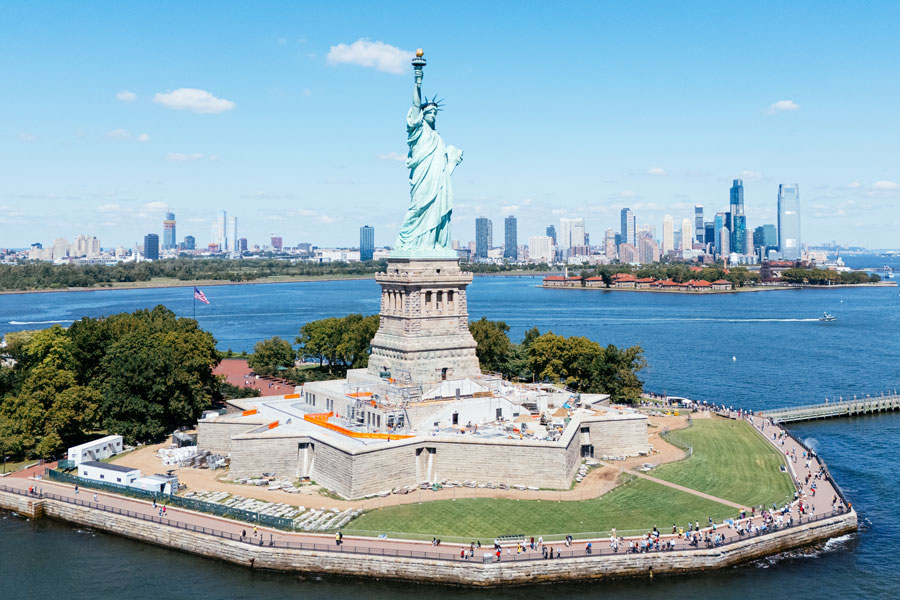
Standing majestically in New York Harbor, just beyond Long Island’s western horizon, the Statue of Liberty remains one of the most recognizable symbols of freedom in the world. This colossal copper monument, officially titled Liberty Enlightening the World, has welcomed visitors to New York Harbor since her dedication on October 28, 1886. For Long Islanders, Lady Liberty is not only a nearby landmark but part of the wider region’s identity – a harbor icon closely tied to the immigrant heritage that shaped the New York metropolitan area.
The statue’s setting in Upper New York Bay makes her a natural destination for travelers exploring both Long Island and the New York City area. Rising about 305 feet from the ground to the torch, with the statue itself measuring roughly 151 feet, this landmark remains one of the great engineering and artistic achievements of the 19th century.
Historical Origins: A Gift from France
The Statue of Liberty’s story begins in France in 1865. Édouard René de Laboulaye, a prominent French political thinker, legal scholar, and abolitionist, proposed creating a monument for the United States that would celebrate liberty and honor the long friendship between France and America.
Laboulaye believed that the Union victory in the American Civil War and the abolition of slavery gave powerful meaning to the ideals of freedom and democracy. His proposal also reflected hopes that democratic reform might take deeper root in France. From the start, the project carried both political and symbolic weight: France would fund the statue, and the United States would fund the pedestal.
Frédéric Auguste Bartholdi’s Artistic Vision
Among those inspired by Laboulaye’s idea was sculptor Frédéric Auguste Bartholdi, who transformed the concept into one of the world’s great monuments. Bartholdi envisioned a monumental female figure carrying a torch aloft, drawing on the imagery of Libertas, the ancient Roman goddess of liberty, while adapting the form to a bold modern neoclassical style.
He spent years refining the design through models of increasing scale, carefully preserving the statue’s proportions as it grew from concept to colossal reality. In 1875, Laboulaye formally announced the project and launched the Franco-American Union to coordinate fundraising and public support.
Design and Symbolism: Every Detail Tells a Story
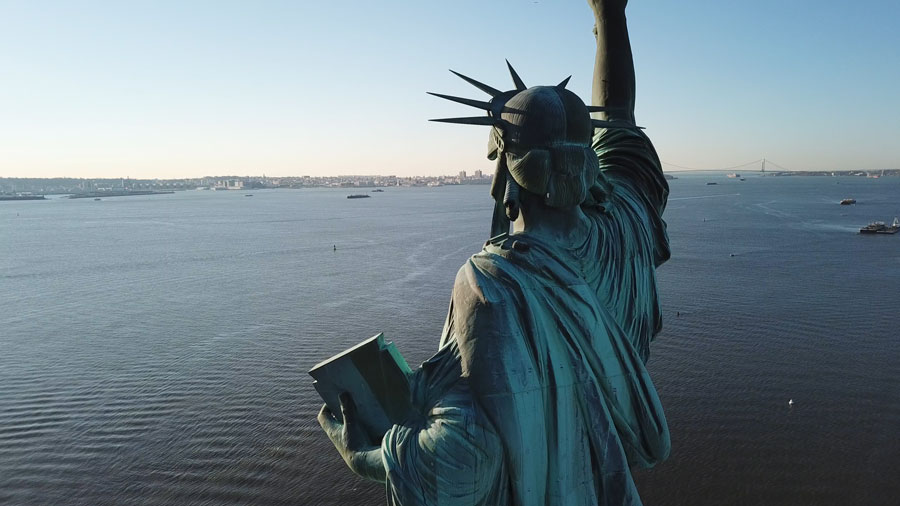
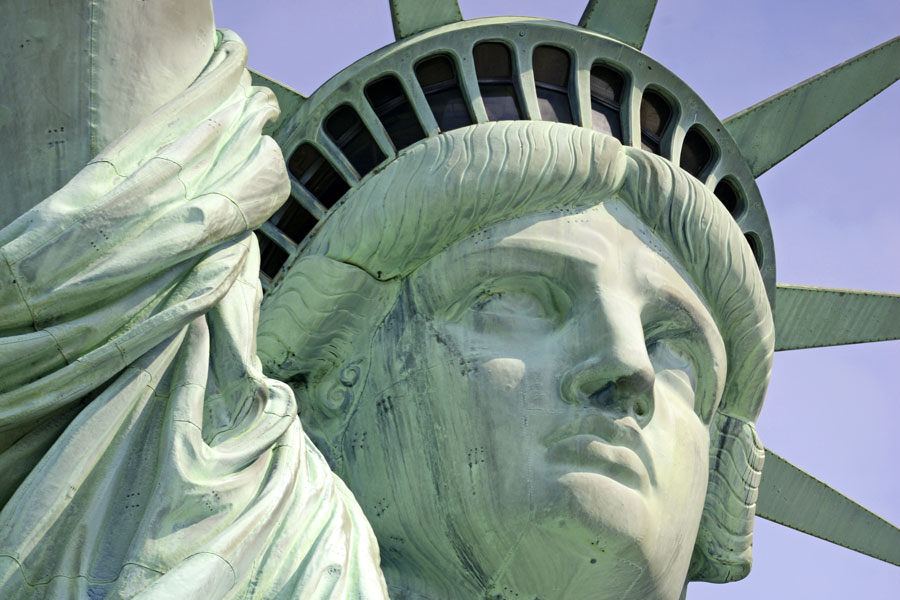
The statue’s crown features seven rays, commonly understood to represent the seven continents and seven seas, emphasizing liberty as a universal ideal. The crown also contains 25 windows, which crown-ticket visitors can look out from for sweeping views of New York Harbor.
In Lady Liberty’s raised right hand is a torch covered in 24-karat gold leaf. The torch symbolizes enlightenment – the idea that liberty and knowledge light the way forward.
In her left hand, she carries a tabula ansata, a tablet associated with law, inscribed with JULY IV MDCCLXXVI – the date of the Declaration of Independence in Roman numerals.
At her feet are broken chains and shackles, partly concealed by her robes. This detail symbolizes freedom from oppression and is closely connected to the monument’s deeper meanings around emancipation and human liberty.
The Classical Design
Bartholdi used broad forms and strong, simplified lines so the statue would read clearly from great distances. Her classical stance creates both stability and motion, suggesting a figure rooted in principle yet stepping forward into the future.
Construction: A Marvel of Engineering
While Bartholdi supplied the artistic vision, the monument required equally ambitious engineering. After the death of architect Eugène Viollet-le-Duc, Alexandre-Gustave Eiffel and his team helped develop the internal structural system that would allow the statue to withstand wind, weather, and temperature swings in New York Harbor.
The result was a flexible iron framework supporting a thin outer copper skin. Rather than making the exterior load-bearing, the structure allowed the copper to expand, contract, and move slightly without failing – a remarkably advanced solution for its era.
The statue can sway slightly in strong winds, and the torch can move even more. That flexibility is part of what has helped the monument endure for well over a century.
The Repoussé Technique
The outer skin consists of hand-shaped copper sheets formed using the repoussé technique, in which metal is hammered over molds to produce detailed sculptural surfaces. The copper is surprisingly thin – about the thickness of two stacked pennies – yet when supported by the interior framework it creates a durable monumental shell.
This method made the statue relatively light for its scale and also made it possible to disassemble the monument, ship it across the Atlantic, and reassemble it in New York.
Construction in Paris
The statue was built in France between 1875 and 1884. Sections were assembled in Paris as they were completed, giving the public glimpses of the emerging monument before it was ultimately taken apart for shipment to the United States.
On July 4, 1884, France formally presented the statue to the United States in Paris. The completed work would soon begin its transatlantic journey to its future home in New York Harbor.
Building the Pedestal: The American Challenge
Americans were responsible for financing and constructing the pedestal. In 1881, architect Richard Morris Hunt designed the base, creating a powerful but restrained form that would elevate the statue without overwhelming it.
The pedestal rises from within Fort Wood, a former defensive fortification laid out in an eleven-point star. This dramatic foundation still gives Liberty Island one of the most distinctive built landscapes in the harbor.
The Funding Crisis and Joseph Pulitzer’s Campaign
Raising money for the pedestal proved difficult. By the mid-1880s, the statue had arrived in New York in crates, but funding for the base lagged badly. Newspaper publisher Joseph Pulitzer then launched a highly effective public fundraising campaign through the New York World, inviting ordinary Americans to contribute any amount and promising to print donors’ names.
The campaign succeeded, and thousands of small donations helped finish the pedestal in 1886. The statue could then be reassembled on Liberty Island.
Dedication and Early History
The Statue of Liberty was dedicated on October 28, 1886, in a major public celebration marked by parades, harbor pageantry, speeches, and enormous crowds. President Grover Cleveland accepted the monument on behalf of the American people.
The island was then known as Bedloe’s Island; it was officially renamed Liberty Island in the 20th century. From the beginning, the monument was both a civic landmark and a public spectacle, instantly recognizable in the harbor skyline.
From Copper to Green: The Patina
When first erected, the Statue of Liberty had the reddish-brown color of new copper. Over time, exposure to air, moisture, and the marine environment created the now-famous blue-green patina.
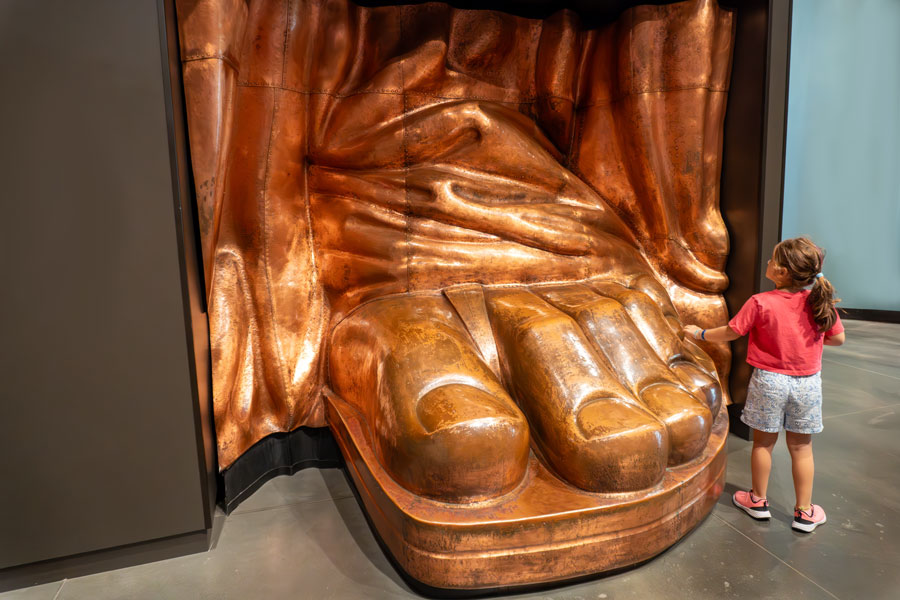
Far from being damage, the patina acts as a protective layer that helps preserve the copper underneath. It is one of the reasons the monument has weathered the harbor environment so successfully for generations.
Emma Lazarus and “The New Colossus”
In 1883, poet Emma Lazarus wrote The New Colossus to support fundraising for the pedestal. Her poem was not originally central to the statue’s meaning, but over time it profoundly reshaped how Americans understood the monument.
Lazarus’s famous lines – “Give me your tired, your poor, / Your huddled masses yearning to breathe free” – recast the statue as a symbol of refuge, hope, and arrival. A bronze plaque bearing the poem was installed inside the pedestal in 1903.
That transformation helped turn the statue from a monument to republican ideals and Franco-American friendship into the enduring “Mother of Exiles” known around the world.
Ellis Island and Immigration: Gateway to America
The connection between the Statue of Liberty and immigration deepened with the opening of Ellis Island Immigration Station in 1892. Located just a short distance from Liberty Island, Ellis Island became the nation’s busiest immigration inspection station, operating until 1954.
Nearly 12 million immigrants passed through Ellis Island. For many, the Statue of Liberty was among the most memorable first sights of America – a visual promise of safety, opportunity, and a new beginning.
Together, Liberty Island and Ellis Island form one of the most meaningful historic landscapes in the United States, linking national ideals to millions of personal family stories.
The Torch: Original and Restored
The torch has one of the most complicated histories of any part of the monument. Early lighting plans changed several times, and later alterations introduced water infiltration problems that damaged the arm and torch assembly over the years.
Public access to the torch has long been closed, and visitors cannot climb into it today. During the major restoration of the 1980s, the original torch was replaced with a new torch based on Bartholdi’s intended design and finished with gold leaf.
The Black Tom Explosion
In 1916, the Black Tom explosion in Jersey City sent shrapnel across the harbor and damaged the statue. The blast contributed to the permanent closure of torch access, a restriction that remains in place.
The 1986 Replacement
As part of the centennial restoration completed in 1986, conservators removed the compromised original torch and installed a carefully crafted replacement. The original torch is now displayed inside the Statue of Liberty Museum, where all island visitors can see it.
The 1980s Restoration: A Monument in Distress
By the early 1980s, weather, age, and earlier modifications had taken a serious toll on the monument. Conservators found structural corrosion, deterioration in the armature system, and widespread need for repairs.
An Unprecedented Restoration Effort
A major public-private restoration effort led by the National Park Service and the Statue of Liberty-Ellis Island Foundation helped return the monument to long-term stability. Thousands of individual components were repaired or replaced, and the statue’s internal support system was modernized where necessary.
The work was completed in time for the 1986 centennial celebration, ensuring that the statue would remain secure and visitable for future generations.
Liberty Weekend: July 4, 1986
The reopening was marked by a high-profile centennial celebration known as Liberty Weekend. The event included tall ships, fireworks, international attention, and ceremonies recognizing the statue’s place as both a national monument and global symbol.
Hurricane Sandy and Resilience
In late 2012, Hurricane Sandy caused severe damage across the harbor region. While the statue itself came through largely intact, Liberty Island’s docks, utilities, walkways, and other visitor infrastructure suffered major impacts.
The monument had just reopened after a separate renovation project when the storm forced another closure. Repairs and resilience upgrades followed, with improvements designed to better withstand future coastal flooding and severe weather.
The Recovery
The National Park Service and partner agencies rebuilt damaged public areas and strengthened island systems. Liberty Island reopened to visitors on July 4, 2013, restoring access to one of the harbor’s defining destinations.
Visiting the Statue Today: Access and Tickets
The Statue of Liberty remains one of the most visited attractions in the United States. Access is by ferry only, and the National Park Service directs most visitors to the official concessioner, Statue City Cruises, for transportation from Battery Park in Manhattan or Liberty State Park in Jersey City. Service details, schedules, and screening procedures can change, so it is wise to check ahead before visiting.
Most ferry tickets include round-trip transportation, access to Liberty Island and Ellis Island, and entry to the museums on both islands. Audio tours are generally available, though languages, formats, and seasonal offerings may vary.
Ticket Types and Access Levels
Visitors typically choose from three main levels of access:
- Grounds / Reserve Access: Ferry transportation, Liberty Island grounds, Ellis Island, and museum access. This is the most common option and works well for visitors who want the harbor views and museum experience without entering the monument’s interior.
- Pedestal Access: Includes the grounds and museum benefits above, plus admission to the pedestal area and its viewing levels.
- Crown Access: The most limited ticket type. Crown visitors climb a narrow stairway from the pedestal into the crown. Tickets often sell out well in advance, and availability, height requirements, and other restrictions should be confirmed through the official ticketing source.
Security and Practical Considerations
Visitors should expect airport-style security screening. Prohibited-item rules may change, and large bags or bulky items are often restricted inside the monument. Lockers are typically available near the screening area for items not permitted in the pedestal or crown.
The climb to the crown is strenuous and takes place in a tight interior space that can become warm, especially in summer. Anyone considering crown access should review current National Park Service guidance and honestly assess comfort with stairs, heat, and enclosed spaces.
The Museums
- The Statue of Liberty Museum, opened in 2019, is accessible to Liberty Island visitors and features exhibits on the statue’s history, construction, meaning, and preservation. Its signature artifact is the original torch.
- The Ellis Island National Museum of Immigration explores the immigration experience through restored historic spaces, exhibits, archival material, and family-history resources.
The Statue’s Connection to Long Island
For Long Islanders, the Statue of Liberty holds a special place in the regional imagination. Although located in Upper New York Bay, she remains part of the same harbor story that shaped western Long Island, New York City, and the surrounding coast. On clear days, the monument may be glimpsed from some western waterfront viewpoints, but even when not visible, its symbolic presence is felt throughout the region.
Many Long Island families also have direct ancestral ties to Ellis Island and New York Harbor. For them, the statue represents not just national history but personal history.
Transportation from Long Island
Long Islanders often reach the Statue of Liberty by taking the Long Island Rail Road to Penn Station in Manhattan, then continuing by subway or local transit to Battery Park. Travel time varies considerably depending on where you start on Long Island and how connections line up.
Another common option is driving to Liberty State Park in Jersey City for the New Jersey ferry departure. This can be convenient for some travelers, especially those who prefer avoiding Lower Manhattan, but parking availability, fees, and traffic conditions can change and should be checked ahead of time.
Cultural Impact and Legacy
The Statue of Liberty has become one of the most recognizable symbols in global popular culture. She appears in films, literature, visual art, news imagery, and political commentary, often as shorthand for freedom, democracy, immigration, New York, or the United States as a whole.
That visibility has also made the monument a powerful site of reflection and debate. The statue has been embraced by immigrants, reformers, activists, and everyday visitors seeking meaning in the ideals she represents.
UNESCO World Heritage Site
In 1984, the Statue of Liberty was inscribed as a UNESCO World Heritage Site. The designation recognizes the monument as a masterpiece of art and engineering as well as one of the world’s most powerful civic symbols.
A Living Symbol
What makes the Statue of Liberty remarkable is not only her scale or beauty, but the way her meaning has continued to evolve. She has stood for Franco-American friendship, emancipation, immigration, aspiration, protest, memory, and hope – sometimes all at once.
That flexibility helps explain her enduring force. The monument still speaks to visitors from around the world, even as each generation sees something slightly different in her raised torch.
Fun Facts and Trivia
- The statue’s official name is Liberty Enlightening the World.
- The monument stands on Liberty Island, but its pedestal is built within the star-shaped walls of Fort Wood.
- The index finger is about 8 feet long.
- Each foot measures more than 9 feet long.
- The crown has 25 windows and seven rays.
- The statue’s copper skin is only about 3/32 of an inch thick.
- The original torch is preserved in the Statue of Liberty Museum.
- The monument was designated a UNESCO World Heritage Site in 1984.
Visiting Tips for Long Islanders
- Book ahead: Pedestal and especially crown access can sell out well in advance.
- Allow extra time: Ferry boarding and security screening can take longer than first-time visitors expect.
- Travel light: Monument-access rules limit what you can bring inside.
- Wear comfortable shoes: Even without crown access, expect substantial walking on Liberty Island and Ellis Island.
- Plan for a half-day or full-day visit: Adding Ellis Island and both museums makes the outing much more rewarding.
- Check conditions before you go: Weather, ferry schedules, and security procedures may affect the visit.
An Enduring Beacon
For nearly 140 years, the Statue of Liberty has stood watch over New York Harbor, her torch raised high as a beacon of freedom. For Long Islanders and for people across the New York region, she remains more than a landmark – she is a lasting expression of memory, aspiration, and civic identity.
Whether viewed from a harbor ferry, explored up close on Liberty Island, or remembered through family stories tied to Ellis Island, the statue continues to carry the meanings people bring to her: liberty, arrival, dignity, and hope.
The Statue of Liberty belongs to everyone who cherishes freedom, and that includes the people of Long Island, whose region she has symbolically greeted for generations and whose families continue to find inspiration in her enduring message.
The Statue of Liberty – Liberty Island
Snapshot
| Key Facts & Details – Statue of Liberty | Details |
|---|---|
| Official Name | Liberty Enlightening the World |
| Type | National Monument & UNESCO World Heritage Site |
| Location | Liberty Island, Upper New York Bay, New York, NY 10004 |
| GPS | 40.689249, -74.044500 |
| Height | About 305 ft from ground to torch; statue alone about 151 ft |
| Materials | Copper skin over an internal support structure |
| Designer / Engineer | Sculptor: Frédéric Auguste Bartholdi; engineering work associated with Eugène Viollet-le-Duc and Alexandre-Gustave Eiffel |
| Concept & Funding | Proposed by Édouard de Laboulaye; France funded the statue and Americans funded the pedestal |
| Pedestal Architect | Richard Morris Hunt, within Fort Wood’s 11-point star |
| Construction | Built in Paris, shipped in pieces, and assembled in New York before dedication in 1886 |
| Dedication | October 28, 1886 |
| Symbolism | Torch = enlightenment; tablet dated JULY IV MDCCLXXVI; crown rays = universal liberty; broken chains at feet = freedom from oppression |
| Patina | Natural oxidation that protects the copper surface |
| Major Restorations | Major centennial restoration in the 1980s; resilience and infrastructure work after Hurricane Sandy |
| Access Levels | Grounds/Reserve, Pedestal, and limited Crown access |
| Ferry & Tickets | Official ferry service is handled by Statue City Cruises; check current schedules and ticket options before visiting |
| Museums | Statue of Liberty Museum and Ellis Island National Museum of Immigration |
| Long Island Note | Often visited as a day trip via LIRR and Lower Manhattan connections, or by driving to the New Jersey departure point |
| Managing Agency | U.S. National Park Service |
| Official Websites | nps.gov/stli Official ferry and ticket information |
The Statue of Liberty stands as far more than a famous landmark – it is a symbol of freedom, resilience, and the enduring promise of opportunity. Although located on Liberty Island, it remains an integral part of the greater New York region and one of the most memorable day trips for Long Islanders. Whether you’re exploring nearby Ellis Island, taking in the views of New York Harbor, or continuing your journey through Manhattan and New York City, Lady Liberty remains an enduring reminder of the history, culture, and ideals that continue to define the region today.
Are you ready for fall on Long Island? Check out these local seasonal guides:
🍎 Apple Picking 🍓 Strawberry Picking 🎃 Pumpkin Picking 👻 Haunted Houses 🍂 Farm Festivals