
Long Beach Bar Lighthouse
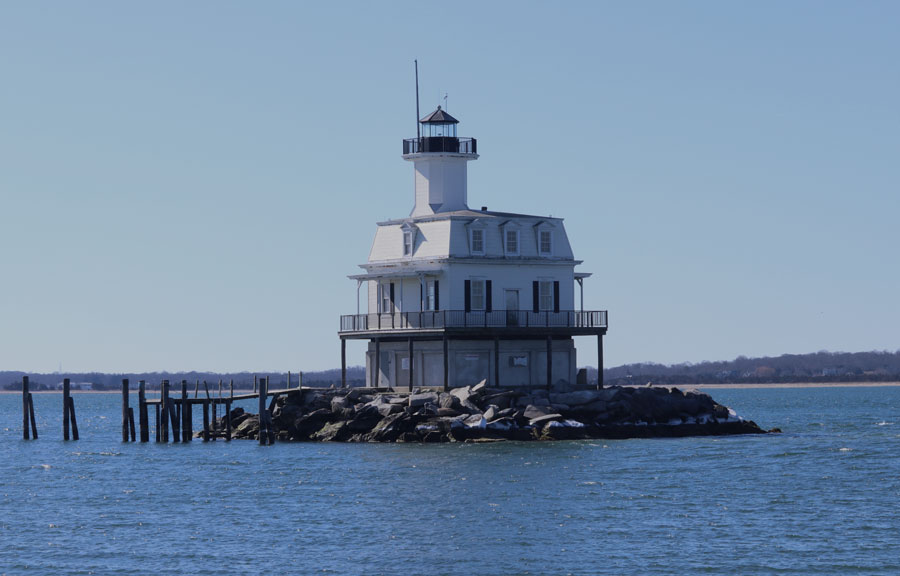
Long Beach Bar Lighthouse, also known as “Bug Light,” stands on a concrete foundation in Gardiners Bay near the entrance to Orient Harbor. Located off the eastern end of Orient in Suffolk County, the lighthouse marks the hazardous Long Beach Bar sandbar between Orient Harbor and the surrounding waters of eastern Long Island.
The original lighthouse was built in 1871 on a screwpile foundation, giving it the appearance of a large insect standing above the water. The structure was destroyed by fire in 1963, but local residents, mariners and preservationists raised the money to construct a near-replica on the surviving foundation in 1990. The rebuilt lighthouse continues to serve as a navigational aid and remains one of the most recognizable maritime landmarks on the North Fork.
Why Long Beach Bar Lighthouse Was Built
Long Beach Bar is a long, shallow sandbar extending near the entrance to Orient Harbor. The obstruction created a serious hazard for fishing boats, oyster vessels and other craft traveling between Peconic Bay, Gardiners Bay and Long Island Sound.
Local fishermen and residents had petitioned the federal government for a lighthouse to identify the dangerous bar and guide vessels through the area. Congress appropriated $17,000 for construction in 1870, and the new lighthouse displayed its first light on December 1, 1871.
The Original “Bug Light”
The original Long Beach Bar Lighthouse was a screwpile structure supported by iron piles driven deep into the sandy bottom of the bay. From a distance, the elevated keeper’s dwelling and its narrow supporting legs appeared to resemble a giant water bug, leading to the nickname “Bug Light.”
The two-story wooden keeper’s dwelling had a mansard roof and an attached square tower with beveled edges. A fifth-order Fresnel lens displayed a fixed red light approximately 54 feet above the water, while a mechanically operated fog bell warned mariners during periods of poor visibility.
Ice, Storms and Life at the Station
Life at Long Beach Bar Lighthouse was difficult because the structure stood in exposed waters subject to heavy storms, strong currents and thick winter ice. Ice repeatedly damaged the screwpile foundation, and a breakwater was constructed in the 1870s to provide additional protection.
In 1926, a reinforced concrete foundation was installed beneath the lighthouse to strengthen the station and protect it from the forces of the bay. The improvements also included a central steam-heating system and a modern bathroom for the keepers and their families.
Deactivation and Destruction
Long Beach Bar Lighthouse was taken out of commission in 1948 after the sandbar extended beyond the structure and reduced its usefulness as a channel marker. The lighthouse was later sold at auction to a local historical association for $1,710.
On July 4, 1963, a fire set by arsonists destroyed the lighthouse. The concrete foundation survived, but the original keeper’s dwelling and tower were lost. For more than two decades, the site remained without the distinctive lighthouse that had become associated with Orient Harbor.
The 1990 Reconstruction
A major preservation campaign led by the East End Seaport Museum and local supporters raised approximately $140,000 to rebuild the lighthouse. Using historic drawings, the new structure was constructed at the Greenport Yacht and Shipbuilding Company in 1990.
The replica was assembled in sections, transported by barge and lifted onto the original concrete foundation. A solar-powered beacon was installed, and the lighthouse was relit during a public celebration in September 1990. The reconstruction helped inspire the organization that became the East End Seaport Museum.
Can the Public Visit Long Beach Bar Lighthouse?
Long Beach Bar Lighthouse is not ordinarily open for public interior visits. The structure stands offshore in navigable waters, and visitors should not attempt to land there without authorization. The lighthouse is best viewed from a boat, from authorized excursions or from shoreline viewpoints around Orient Harbor.
The East End Seaport Museum in Greenport provides exhibits and programs about Long Island’s maritime history and surrounding lighthouses. Boat routes, viewing opportunities and seasonal schedules may vary.
Long Beach Bar Lighthouse and the North Fork
Long Beach Bar Lighthouse is part of the network of historic navigation landmarks surrounding the eastern end of Long Island. Nearby lights include Plum Island Lighthouse, Orient Point Lighthouse, Little Gull Island Lighthouse and Race Rock Lighthouse.
Although it cannot be visited like a conventional land-based attraction, Bug Light remains an important landmark for boaters entering Orient Harbor and traveling through the waters surrounding the North Fork. Its unusual appearance, dramatic history and community-led reconstruction make it one of the most distinctive lighthouses associated with Long Island.
Long Beach Bar Lighthouse
Key Facts & Details
| Feature | Details |
|---|---|
| Official name | Long Beach Bar Light |
| Common names | Long Beach Bar Lighthouse and “Bug Light” |
| Type | Historic lighthouse and active aid to navigation |
| Location | Long Beach Bar near the entrance to Orient Harbor |
| Nearby community | Orient |
| County | Suffolk County |
| Waterway | Gardiners Bay, Orient Harbor and Long Island Sound |
| Original station established | 1871 |
| Original construction funding | $17,000 appropriated by Congress in 1870 |
| Original foundation | Screwpile foundation driven into the sandy bottom |
| Original construction materials | Wood-frame keeper’s dwelling with an attached tower |
| Original lens | Fifth-order Fresnel lens |
| Original light | Fixed red light approximately 54 feet above the water |
| Fog signal | Mechanically operated fog bell |
| Concrete foundation added | 1926 |
| Original lighthouse destroyed | Fire on July 4, 1963 |
| Replacement lighthouse completed | 1990 |
| Current foundation | Surviving reinforced concrete foundation from the original station |
| Current light | Solar-powered navigational beacon |
| Current status | Active aid to navigation maintained by the United States Coast Guard |
| Structure owner | East End Seaport Museum |
| Public access | Not ordinarily open for public interior visits; best viewed from the water or authorized viewpoints |
| Coordinates | 41.10909, -72.30598 |
| Official historical source | U.S. Coast Guard Historian’s Office |
| Long Island Lighthouses | How many lighthouses are on Long Island? |
Long Beach Bar Lighthouse, better known as Bug Light, remains one of the most unusual maritime landmarks near Orient. First lit in 1871, destroyed by fire in 1963 and rebuilt by local supporters in 1990, the lighthouse continues to mark the dangerous Long Beach Bar and guide vessels entering Orient Harbor. The lighthouse is not ordinarily open to visitors, but it can be viewed from the surrounding waters and shoreline viewpoints. Its surviving foundation, distinctive design and community-led restoration make Bug Light an important part of the maritime heritage of the North Fork and Suffolk County.
Are you ready for fall on Long Island? Check out these local seasonal guides:
🍎 Apple Picking 🍓 Strawberry Picking 🎃 Pumpkin Picking 👻 Haunted Houses 🍂 Farm Festivals