
How wide is Long Island?
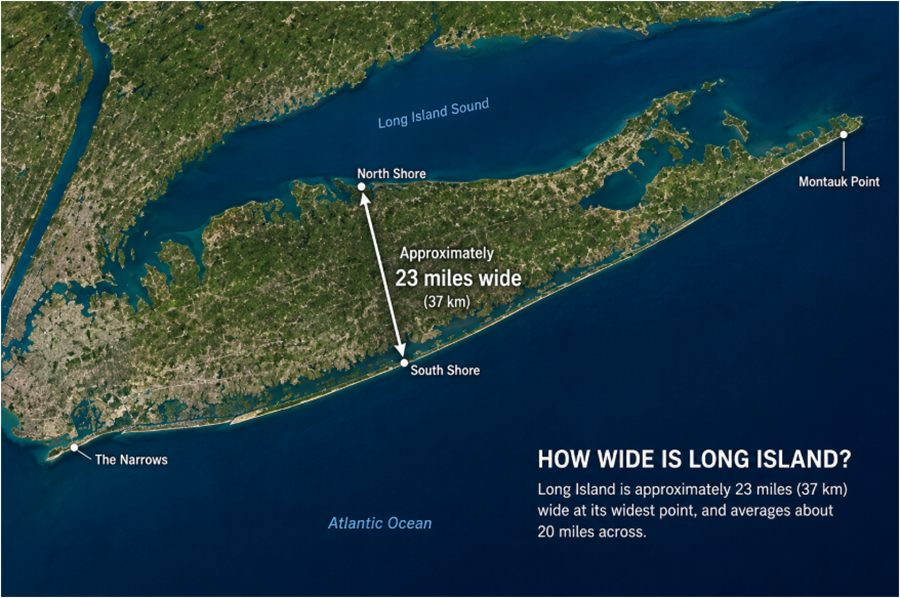
Long Island is approximately 23 miles (37 kilometers) wide at its widest point, although its width varies considerably along its 118-mile length. On average, the island measures about 20 miles (32 kilometers) from the shores of Long Island Sound to the beaches of the Atlantic Ocean, giving it the long, narrow shape for which it is named.
In Short
Long Island reaches a maximum width of about 23 miles (37 kilometers) and averages roughly 20 miles (32 kilometers) across. Its relatively narrow width, compared to its 118-mile length, is what inspired the island’s descriptive name.
How Wide Is Long Island?
Although Long Island stretches approximately 118 miles from west to east, it remains relatively narrow from north to south. At its widest point, the island measures about 23 miles across, while most areas average closer to 20 miles between Long Island Sound and the Atlantic Ocean.
The island’s narrow shape has played a significant role in its development. Communities along the North Shore enjoy harbors, inlets, and views of Long Island Sound, while those on the South Shore are known for their ocean beaches, barrier islands, and access to the Atlantic Ocean. In many places, it is possible to drive from one shoreline to the other in less than an hour.
Despite its modest width, Long Island encompasses an extraordinary variety of landscapes, including dense urban neighborhoods in Brooklyn and Queens, suburban communities throughout Nassau County and Suffolk County, protected forests, farmland, vineyards, and hundreds of miles of coastline.
The combination of a relatively narrow width and a long east-west span has helped shape Long Island’s transportation network, regional identities, and recreational opportunities. Whether exploring the villages of the North Fork, the beaches of the South Fork, or the communities stretching from New York City to Montauk, visitors are never far from the water.
Quick Facts
| Category | Information |
|---|---|
| Maximum Width | Approximately 23 miles (37 km) |
| Average Width | Approximately 20 miles (32 km) |
| Length | Approximately 118 miles (190 km) |
| Northern Shoreline | Long Island Sound and the North Shore |
| Southern Shoreline | Atlantic Ocean and the South Shore |
| Located In | New York State |
| Includes | Brooklyn, Queens, Nassau County, and Suffolk County |
While Long Island is relatively narrow from north to south, its geography has created two distinctly different coastlines separated by only a short drive. From the harbors and bluffs of the North Shore to the sandy beaches of the South Shore, the island’s compact width allows residents and visitors to experience a remarkable diversity of landscapes, communities, and outdoor recreation within a relatively small area.
Are you ready for fall on Long Island? Check out these local seasonal guides:
🍎 Apple Picking 🍓 Strawberry Picking 🎃 Pumpkin Picking 👻 Haunted Houses 🍂 Farm Festivals