
Eatons Neck Lighthouse
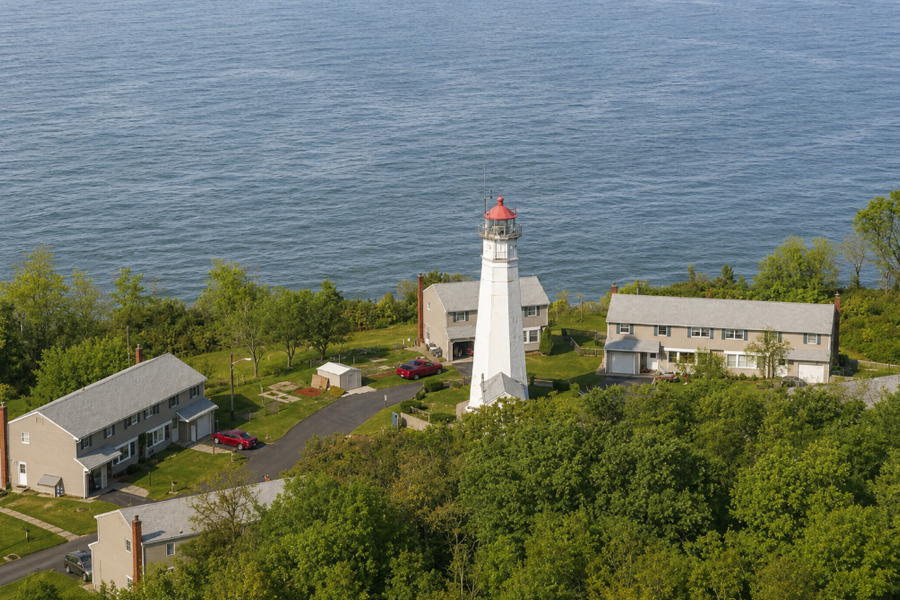
Eaton’s Neck Lighthouse is a historic active lighthouse at the northern tip of Eaton’s Neck in Suffolk County. Standing above the entrance to Huntington Bay and Long Island Sound, the lighthouse has guided vessels along the North Shore of Long Island since 1799.
Built during the administration of President John Adams, Eaton’s Neck Lighthouse is the second-oldest lighthouse on Long Island and one of only two surviving eighteenth-century lighthouses in New York State. The station remains an operational aid to navigation and is located within an active United States Coast Guard facility.
Construction of the Lighthouse
Congress appropriated $13,250 for the construction of a lighthouse at Eaton’s Neck on March 14, 1798. Ten acres were purchased from John Gardiner that June, and President Adams authorized construction on July 2. The lighthouse was completed by December 6, 1798, and its light was first displayed on January 1, 1799.
The tower was designed by architect John McComb Jr., who also worked on other important early federal buildings. Constructed of fieldstone with a brick lining, the octagonal pyramidal tower was built on a dressed-stone and timber foundation. The lighthouse originally stood with a separate keeper’s residence and supporting station buildings.
Improving the Light
Early inspections found that the original lighting system was not visible from a sufficient distance. In 1838, twelve lamps with 13-inch reflectors were installed to improve the lighthouse’s range. Additional reflector improvements followed during the nineteenth century.
A new lantern and third-order Fresnel lens were installed in 1858. The lens produced a fixed white light that could be seen by vessels approaching the entrance to Huntington Bay and traveling through the western waters of Long Island Sound.
Nineteenth-Century Renovations
Congress approved funds for major renovations in 1867. The work included replacing the original wooden stairs with iron stairs and landings, lining the interior walls with brick, enlarging the keeper’s quarters and installing a steam-powered fog signal.
The keeper’s residence was renovated again in 1880. For generations, lighthouse keepers and their families maintained the light, monitored weather and sea conditions, and supported the safety of mariners navigating the rocky waters around Eaton’s Neck.
Automation and the Coast Guard Station
The lighthouse was converted from oil illumination to an oil-vapor lamp in 1907 and electrified in 1921. Automation followed in the twentieth century, ending the need for a resident lighthouse keeper. The United States Coast Guard continues to maintain the navigational light.
The lighthouse is located beside Coast Guard Station Eaton’s Neck, a historic maritime safety station established in 1849. The station’s crews have long assisted boaters and responded to emergencies in Huntington Bay, Long Island Sound and the surrounding North Shore waters.
National Register of Historic Places
Eaton’s Neck Lighthouse was listed on the National Register of Historic Places in 1973. The designation helped protect the lighthouse from proposed demolition and recognized its architectural significance, early federal history and continuing role in maritime navigation.
The lighthouse is especially important because it retains its eighteenth-century tower and remains an active navigational landmark. Along with Montauk Point Lighthouse, it represents one of the earliest surviving lighthouse traditions in New York State.
Can the Public Visit Eaton’s Neck Lighthouse?
Eaton’s Neck Lighthouse stands on the grounds of an active Coast Guard station and is not open for ordinary public tours. Visitors should not enter the station or approach the lighthouse without official authorization. The best way to view the landmark is from the surrounding waters or from authorized shoreline locations.
Boaters traveling near Eaton’s Neck should follow all navigation regulations and remain alert for shoals, rocks, strong currents and other hazards near the entrance to Huntington Bay. The lighthouse remains an active aid to navigation, even though the station grounds are closed to the public.
Eaton’s Neck and the North Shore
Eaton’s Neck Lighthouse is part of the historic maritime landscape surrounding Northport, Huntington, Huntington Bay and the western end of Long Island Sound. The area includes waterfront communities, marinas, beaches and historic properties that reflect Long Island’s longstanding connection to the sea.
The lighthouse can also be viewed in relation to other historic navigation landmarks, including Huntington Harbor Lighthouse. Together, these sites illustrate the network of lights, stations and navigational aids that helped protect vessels moving along Long Island’s North Shore.
Eaton’s Neck Lighthouse
Key Facts & Details
| Feature | Details |
|---|---|
| Official name | Eatons Neck Light |
| Common name | Eaton’s Neck Lighthouse |
| Type | Active historic lighthouse and navigational aid |
| Location | Northern tip of Eaton’s Neck, at the entrance to Huntington Bay |
| Nearby community | Northport |
| County | Suffolk County |
| Waterway | Long Island Sound and Huntington Bay |
| Construction authorized | 1798 |
| Construction completed | December 6, 1798 |
| First lit | January 1, 1799 |
| Architect | John McComb Jr. |
| Original appropriation | $13,250 |
| Original land purchase | Ten acres purchased from John Gardiner for $500 |
| Tower shape | Octagonal pyramidal tower |
| Tower height | Approximately 73 feet |
| Construction materials | Fieldstone with brick lining on a dressed-stone and timber foundation |
| Original lighting | Lamps with reflectors |
| Fresnel lens | Third-order Fresnel lens installed in 1858 |
| Light characteristic | Fixed white light |
| Fog signal | Steam fog signal installed during the 1867 renovations |
| Electrified | 1921 |
| Automated | Twentieth century |
| Historic designation | Listed on the National Register of Historic Places in 1973 |
| Current status | Operational aid to navigation located within an active Coast Guard station |
| Public access | Station grounds and lighthouse closed to ordinary public access |
| Coordinates | 40.95397, -73.396641 |
| Official historical source | U.S. Coast Guard Historian’s Office |
| Long Island Lighthouses | How many lighthouses are on Long Island? |
Eaton’s Neck Lighthouse remains one of Long Island’s most important early maritime landmarks. Built in 1798 and first lit in 1799, the historic tower continues to guide vessels entering Huntington Bay while preserving the architectural character of the nation’s early lighthouse system.
Although the lighthouse and Coast Guard station are not open to ordinary public access, Eaton’s Neck Lighthouse can be appreciated from the water and through its connection to the surrounding North Shore communities. Its age, active navigational role and association with Coast Guard Station Eaton’s Neck make it an important part of Long Island’s maritime history.
Are you ready for fall on Long Island? Check out these local seasonal guides:
🍎 Apple Picking 🍓 Strawberry Picking 🎃 Pumpkin Picking 👻 Haunted Houses 🍂 Farm Festivals