

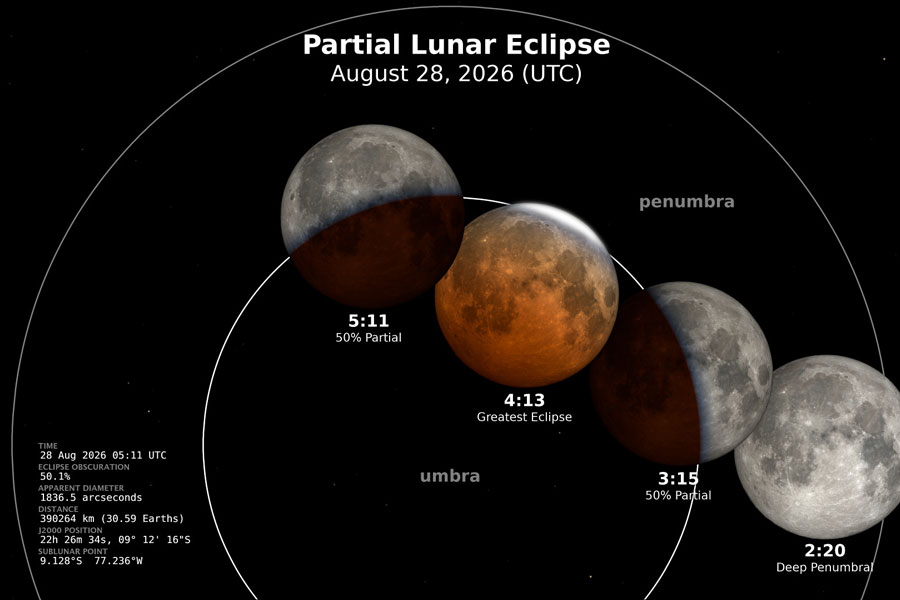
BABYLON, NY – A near-total lunar eclipse will darken more than 96% of the Moon over Long Island late Thursday night, offering residents across Nassau County and potentially even more of Suffolk County an opportunity to see one of the year’s most dramatic astronomical events.
The eclipse will begin subtly at approximately 9:24 p.m. Thursday, August 27, before Earth’s darker central shadow starts moving visibly across the Moon at 10:34 p.m. Maximum eclipse will occur at approximately 12:13 a.m. Friday, when 96.3% of the lunar disk will be covered.
Whether Long Islanders will actually see the spectacle depends on the clouds. Forecasts currently call for humid conditions, scattered thunderstorms and considerable cloud cover Thursday, although breaks may develop overnight and eastern Suffolk could have a somewhat better opportunity than western portions of the Island.
When to Watch the Lunar Eclipse
The eclipse will unfold over more than five hours, but viewers do not need to remain outside for the entire event. The most visually impressive period will begin late Thursday night and continue through approximately 1:30 a.m. Friday.
| Time | Eclipse Stage | What Viewers May See |
|---|---|---|
| 9:24 p.m. Thursday | Penumbral eclipse begins | A subtle dimming that may be difficult to notice |
| 10:34 p.m. | Partial eclipse begins | Earth’s dark shadow begins taking a visible “bite” from the Moon |
| Approximately 11:15 p.m. | Moon about half covered | Earth’s curved shadow becomes especially apparent |
| 12:13 a.m. Friday | Maximum eclipse | 96.3% of the Moon’s disk is covered by the darkest portion of Earth’s shadow |
| 1:52 a.m. | Partial eclipse ends | The Moon leaves the dark central shadow |
| 3:02 a.m. | Penumbral eclipse ends | The eclipse is complete |
The timing applies throughout Long Island. Unlike a solar eclipse, which can only be seen along a limited path, a lunar eclipse is visible from anywhere on the nighttime side of Earth where skies are clear.
Why It Is Not Considered a Total Eclipse
Despite its near-total appearance, the event is officially classified as a deep partial lunar eclipse. At its peak, a thin portion of the Moon will remain outside Earth’s umbra, the darkest central portion of the planet’s shadow.
NASA reports that 96.3% of the Moon’s disk will be inside the umbra at maximum eclipse. Approximately 93% of its width will be covered, a separate measurement sometimes reported as the eclipse’s magnitude.
Most of the covered Moon may appear rusty red, copper or orange. The color develops because sunlight passing through Earth’s atmosphere is filtered and bent toward the lunar surface, allowing more red and orange wavelengths to reach it.
Clouds Could Interfere With the View
The principal obstacle for Long Island will be Thursday’s unsettled weather. The current forecast calls for humid conditions with clouds, showers and possible thunderstorms across the region.
Western Long Island, including much of Nassau County, may experience more persistent cloud cover. Forecasts for Riverhead and the East End indicate that clouds could break for periods, although showers and thunderstorms remain possible there as well.
The outlook does not necessarily mean the eclipse will be completely hidden. Because the partial phase continues for more than three hours, even a temporary opening in the clouds could provide a view. Conditions can also change considerably following afternoon and evening thunderstorms, making an updated forecast Thursday night more useful than the earlier multiday outlook.
How to See It From Long Island
No special glasses, filters or equipment are needed. Lunar eclipses are safe to view directly with the naked eye, according to NASA’s skywatching guidance.
A backyard, neighborhood park or other location with a broad view of the sky should be sufficient. Moving away from bright streetlights can make the Moon’s darker red and copper colors easier to distinguish. Binoculars or a small telescope can provide a closer look at Earth’s curved shadow, but they are optional.
Residents considering a beach or public park should confirm its nighttime operating hours before traveling. The Moon will be well above the horizon during the principal stages, so an oceanfront location is not necessary.
Key Facts and Details
| Event | Deep partial lunar eclipse |
| Date | Thursday, August 27, into Friday, August 28, 2026 |
| Visible From | All of Long Island, weather permitting |
| Partial Eclipse Begins | 10:34 p.m. Thursday |
| Maximum Eclipse | Approximately 12:13 a.m. Friday |
| Partial Eclipse Ends | 1:52 a.m. Friday |
| Maximum Coverage | 96.3% of the Moon’s disk inside Earth’s umbra |
| Expected Appearance | Mostly darkened Moon with possible red, copper or orange coloring |
| Weather Concern | Clouds, showers and possible thunderstorms |
| Potentially Better Conditions | Central and eastern Suffolk if breaks develop in the clouds |
| Viewing Equipment | None required; binoculars or a telescope are optional |
| Eye Protection | Not required for a lunar eclipse |
| Official Source | NASA Scientific Visualization Studio |
If the clouds cooperate, Long Islanders who step outside shortly before midnight Thursday will see Earth’s shadow cover nearly the entire full Moon, leaving only a narrow illuminated edge at the height of the eclipse. Even intermittent breaks in the clouds could be enough to reveal the copper-colored Moon before the shadow begins retreating early Friday morning.
Are you ready for fall on Long Island? Check out these local seasonal guides:
🍎 Apple Picking | 🍂 Fall Festivals & Farm Activities | 👻 Haunted Houses | 🎃 Pumpkin Picking