

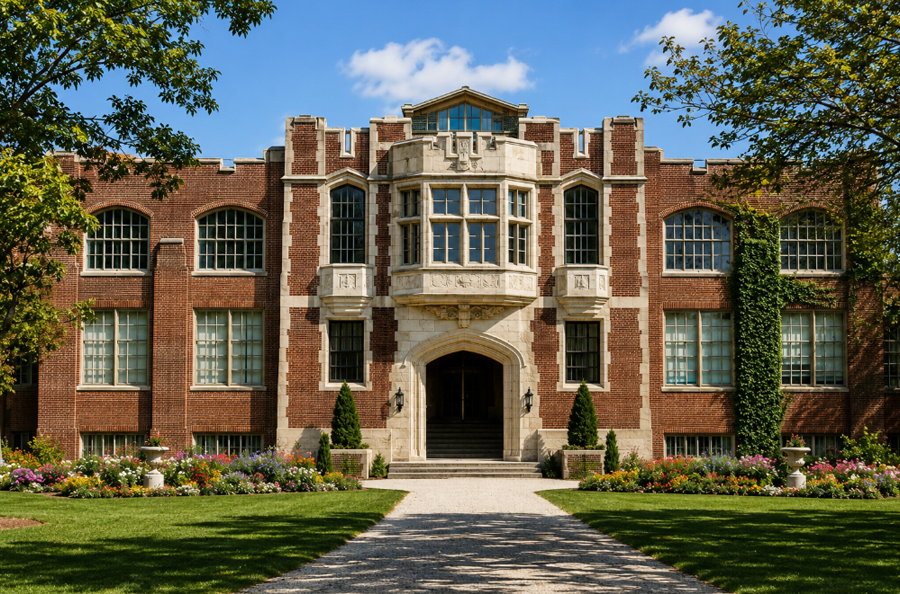
GARDEN CITY, NY – Country Life Press is one of Long Island’s most unusual place names. Best known today as a Long Island Rail Road station in Garden City, the name did not originate with the railroad, a village, or a neighborhood. Instead, it began as the title of a nationally distributed magazine before becoming the name of one of America’s most ambitious publishing complexes. More than a century later, the railroad station, nearby businesses, and surrounding area continue to preserve the legacy of a publishing company that helped shape Long Island history.
The story begins with Country Life in America, an illustrated magazine launched by Doubleday, Page & Company in 1901. At a time when the United States was rapidly urbanizing, the magazine celebrated architecture, gardens, country estates, landscape design, conservation, and outdoor living. Rather than focusing exclusively on farming, it promoted the idea that beautiful surroundings, thoughtful planning, and a closer connection to nature could improve everyday life. The publication became one of the company’s most successful magazines and inspired the name that would soon appear on an entirely new publishing campus.
By 1910, Doubleday’s printing operations had outgrown their facilities in Manhattan. According to the company’s own history, publishing operations had become scattered among more than twenty different locations throughout New York City, creating inefficiencies that made expansion increasingly difficult. Executives concluded they needed a single, modern facility containing at least 150,000 square feet of floor space where every stage of book and magazine production could take place under one roof. The company also wanted abundant natural light, room for future growth, and an environment that reflected the same ideals promoted by Country Life in America. Those goals could no longer be achieved in Manhattan, where land was expensive, buildings were forced upward instead of outward, and industrial space came at a premium. Instead, the company looked east to Long Island.
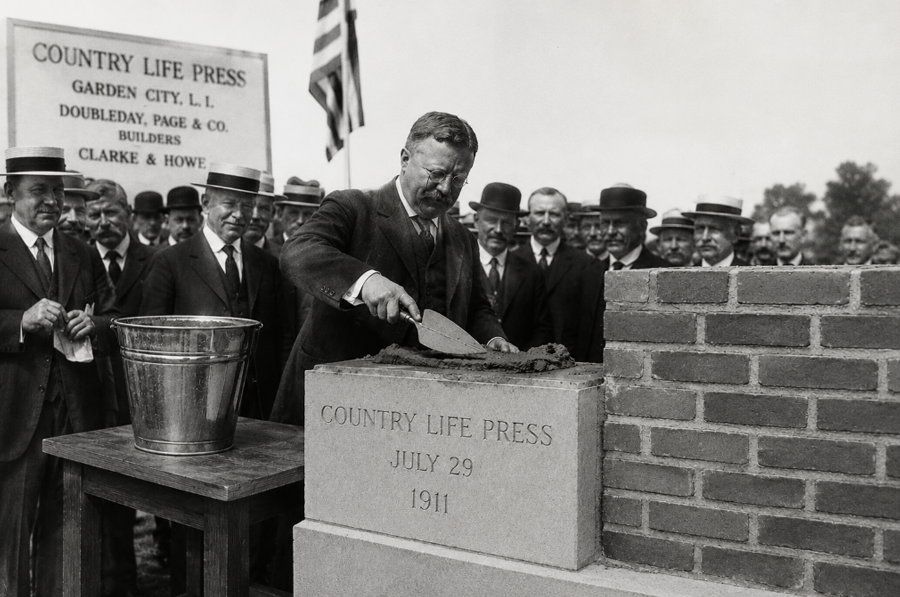
Garden City offered everything Doubleday was seeking. Large tracts of open land provided space to construct an entirely new publishing plant, while the Pennsylvania Railroad’s ongoing improvements to the Long Island Rail Road promised fast, dependable transportation between Long Island and New York City. The company specifically cited the railroad’s modernization as one of the reasons it selected the site, believing it would provide some of the finest rail service in the country. Construction soon began on what became known as Country Life Press, borrowing its name directly from the magazine that had inspired the project.
From the beginning, Country Life Press was intended to be far more than a factory. In a remarkable statement published while the plant was under construction, Doubleday explained that its goal was to create “not merely… a factory to print books and magazines, but a place to spend one’s working hours comfortably and, we truly hope, happily.” That philosophy shaped nearly every aspect of the campus. Instead of constructing a typical industrial complex, the company surrounded its buildings with formal gardens, broad lawns, ornamental trees, walkways, reflecting pools, and one of the campus’s most recognizable features, an elegant sundial. Large windows flooded the workspaces with natural daylight, while the carefully landscaped grounds reflected the same appreciation for beauty and thoughtful design that filled the pages of Country Life in America.
Inside the buildings, the operation quickly became one of the nation’s leading publishing centers. Country Life Press printed not only Country Life in America, but also books, magazines, catalogs, and countless commercial publications distributed across the United States. Many of the country’s best-known authors were published by Doubleday during this era, including Rudyard Kipling, Joseph Conrad, Booth Tarkington, O. Henry, Gene Stratton-Porter, and Kathleen Norris. For decades, readers opening newly purchased books often found the familiar imprint, Garden City, New York, on the copyright page without realizing those volumes had been printed on Long Island.
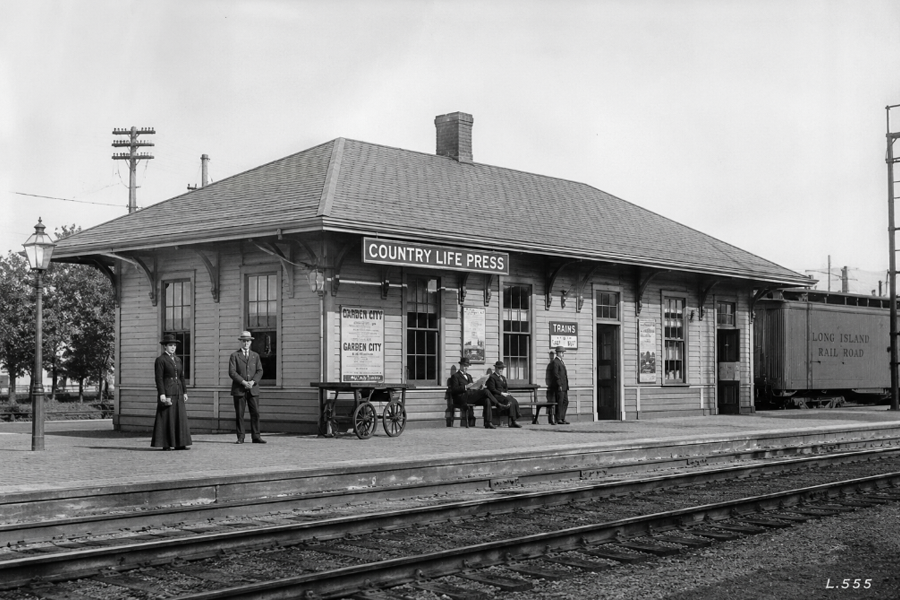
As the publishing campus expanded, hundreds of employees traveled to Garden City each day. Recognizing the importance of the growing facility, the Long Island Rail Road opened Country Life Press station in 1911 to serve the plant. Rather than naming the station after a nearby road or neighborhood, the railroad adopted the name already associated with Doubleday’s publishing operation. It was a practical decision at the time, but one that permanently attached the publishing company’s identity to Long Island’s transportation network.
The magazine itself evolved over the years, eventually changing its name to The New Country Life before later becoming simply Country Life. Although the publication ultimately ceased publication in 1942, the name Country Life Press had already taken on a life of its own. The publishing campus continued operating under changing ownership, while portions of the property were adapted for offices and other commercial uses as the publishing industry evolved throughout the twentieth century. Today, elements of the historic complex remain part of Garden City’s landscape, serving as reminders of the site’s publishing heritage.
More than a century after the first books rolled off the presses, the name Country Life Press continues to appear on railroad maps, business addresses, and conversations among Long Islanders. Most people passing through the station have no idea they are repeating the title of a magazine first published in 1901. Fewer still realize that the station owes its existence to one of America’s largest publishing companies and an extraordinary campus built to demonstrate that industry and beauty could exist side by side.
Perhaps that is Country Life Press’s greatest legacy. What began as the name of a magazine celebrating gardens, architecture, and country living became the identity of a pioneering publishing plant, inspired the creation of a Long Island Rail Road station, and ultimately evolved into one of Long Island’s most distinctive and enduring place names. More than 100 years later, the original magazine has long since disappeared, but the name it inspired remains woven into the history and geography of Garden City.
Today, every train that stops at Country Life Press quietly preserves the legacy of a publishing company that believed beautiful surroundings could inspire better books, better magazines, and a better place to work. Few station names on Long Island carry such an unexpected story.
Historical Sources
Much of the historical information presented in this article was researched from The Country Life Press: Garden City, New York (1913), an original publication issued by Doubleday, Page & Company to document the planning, construction, philosophy, and operations of the Country Life Press publishing complex. Because the book is in the public domain in the United States, readers can explore the original text, photographs, and illustrations online free of charge.
The volume contains hundreds of pages of firsthand accounts, architectural details, historic photographs, and illustrations documenting one of Long Island’s most significant publishing landmarks.
Read the original 1913 publication:
https://archive.org/details/countrylifepress00doub
Are you ready for fall on Long Island? Check out these local seasonal guides:
🍎 Apple Picking | 🍂 Fall Festivals & Farm Activities | 👻 Haunted Houses | 🎃 Pumpkin Picking