
Manhattan Bridge
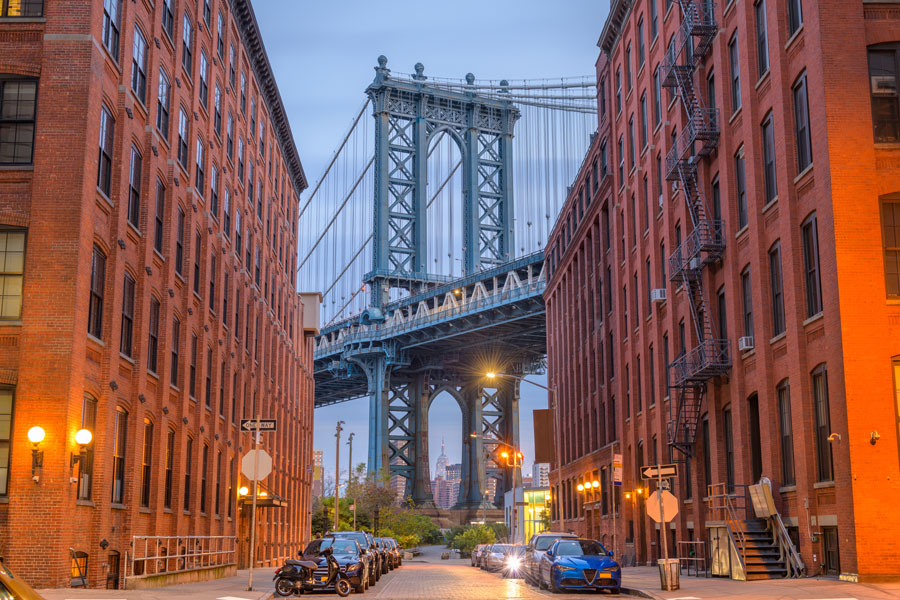
The Manhattan Bridge links Lower Manhattan with Downtown Brooklyn over the East River. Opened on December 31, 1909, it is one of New York City’s major East River crossings and remains a busy route for vehicles, subway riders, pedestrians, and cyclists traveling between Manhattan and the western end of Long Island.
History
- The Manhattan Bridge opened to traffic on December 31, 1909, following years of construction during New York City’s bridge-building era.
- The bridge was designed as a major multi-use crossing, carrying roadway traffic, pedestrians, bicycles, and subway service between Manhattan and Brooklyn.
- Its Manhattan entrance is known for the Manhattan Bridge Arch and Colonnade, a monumental Beaux-Arts gateway at Canal Street.
- The bridge underwent major rehabilitation work during the late twentieth and early twenty-first centuries after decades of heavy roadway and subway use.
Design & Features
- Type: suspension bridge with steel towers and four main cables.
- Main span: about 1,470 ft; total length: about 6,090 ft from portal to portal on the upper roadway.
- Connects: Canal Street in Manhattan with Flatbush Avenue Extension in Brooklyn.
- Traffic: carries motor vehicles, subway trains, pedestrians, and cyclists.
- Subway service: the bridge carries B, D, N, and Q subway service between Manhattan and Brooklyn, though service patterns can vary.
- Toll: Free to cross the bridge itself.
Why it matters for Long Island travelers
Brooklyn occupies the western end of Long Island, and the Manhattan Bridge is one of the key connections between Brooklyn and Manhattan. For Long Island travelers heading through Brooklyn toward Chinatown, SoHo, Little Italy, the Lower East Side, or Downtown Manhattan, the bridge provides a direct toll-free crossing over the East River.
The bridge is also important for transit riders because several major subway lines cross it between Brooklyn and Manhattan. For visitors exploring DUMBO, Downtown Brooklyn, Chinatown, or the Lower Manhattan waterfront, the Manhattan Bridge is both a practical transportation route and a recognizable part of the New York City skyline.
Nearby Landmarks
- DUMBO for cobblestone streets, photo spots, restaurants, galleries, and waterfront views
- Brooklyn Bridge Park for piers, lawns, playgrounds, and East River paths
- Chinatown and Canal Street on the Manhattan side
- Lower East Side for historic streets, restaurants, museums, and nightlife
- Brooklyn Bridge, located nearby and often viewed from the Manhattan Bridge walkway or surrounding waterfront areas
The Manhattan Bridge
Quick Facts
| Crosses | East River |
| Connects | Manhattan Chinatown/Canal Street area ↔ Brooklyn Downtown Brooklyn/DUMBO area |
| Opened | December 31, 1909 |
| Design | Suspension bridge with steel towers |
| Main span / Total length | About 1,470 ft / about 6,090 ft from portal to portal on the upper roadway |
| Subway service | B, D, N, and Q trains; service patterns may vary |
| Walk & bike access | Separate pedestrian and bicycle paths are available; follow posted routing |
| Vehicle access | Motor vehicles use the bridge; follow posted restrictions and traffic rules |
| Toll | No toll to cross the bridge itself |
| Best times to visit | Early morning and late afternoon are popular for skyline views and photography |
Key facts compiled from public historical and municipal sources; access, traffic patterns, subway service, and pedestrian or bicycle routing can change, so check current conditions before visiting.
Q&A – Manhattan Bridge
Q: Where is the Manhattan Bridge?
A: The Manhattan Bridge crosses the East River between Lower Manhattan and Downtown Brooklyn.
Q: Is there a toll on the Manhattan Bridge?
A: No. There is no toll to cross the Manhattan Bridge itself.
Q: Can you walk across the Manhattan Bridge?
A: Yes. Pedestrians can walk across the bridge using the designated pedestrian path. Entrances and routes may change during maintenance or construction, so follow posted signs.
Q: Can you bike across the Manhattan Bridge?
A: Yes. The bridge has bicycle access and is commonly used by cyclists traveling between Manhattan and Brooklyn.
Q: Which subway lines use the Manhattan Bridge?
A: The B, D, N, and Q subway lines use the Manhattan Bridge between Manhattan and Brooklyn, though schedules and service patterns may vary.
Q: How long is the Manhattan Bridge?
A: The main span is about 1,470 feet, and the upper roadway measures about 6,090 feet from portal to portal.
Q: Is the Manhattan Bridge older than the Williamsburg Bridge?
A: No. The Williamsburg Bridge opened in 1903, while the Manhattan Bridge opened later, in 1909.
Q: Why is the Manhattan Bridge important?
A: The bridge is a major East River crossing that connects Manhattan with Brooklyn, which sits on the western end of Long Island. It supports road traffic, subway service, walking, and cycling, making it one of New York City’s most important transportation links.
A Major East River Crossing
The Manhattan Bridge remains one of New York City’s essential East River crossings, linking Lower Manhattan with Downtown Brooklyn and helping move commuters, visitors, drivers, cyclists, and pedestrians between two of the city’s busiest boroughs. For Long Island travelers, it is an important connection between Brooklyn and Manhattan, as well as a landmark bridge with memorable views of the East River, the Brooklyn Bridge, and the surrounding skyline.
Are you ready for fall on Long Island? Check out these local seasonal guides:
🍎 Apple Picking | 🍂 Fall Festivals & Farm Activities | 👻 Haunted Houses | 🎃 Pumpkin Picking