
Media Landscape – A Historical Overview

Long Island’s media ecosystem has evolved alongside its transformation from agrarian communities and maritime villages into one of the most densely populated suburban regions in the United States. From 19th-century local presses to modern cable news networks and digital platforms, media institutions have played a central role in shaping civic discourse, political engagement, and regional identity across Nassau and Suffolk counties.
This page provides a historical overview of the institutions that have defined how Long Islanders receive information and how those institutions have evolved over time.
19th Century Foundations – Early Print Journalism
Long Island’s earliest newspapers emerged in the 1800s, when small printing presses served individual towns and villages. These publications often focused on:
- Shipping and maritime trade
- Agricultural markets
- Local court proceedings
- Church announcements
- Political party positions
Among the earliest significant regional publications was the Long Island Press, founded in 1821. Though originally based in Brooklyn – which was then part of Long Island before New York City consolidation in 1898 – it became an influential daily serving the broader Long Island region.
Throughout the 19th century, newspapers functioned as primary vehicles for:
- Political party messaging
- Public notices
- Legal announcements
- Regional identity formation
Unlike modern journalism, early publications were often openly partisan, aligned with political movements of the era.
Early 20th Century – Suburban Expansion and Consolidation
The early 1900s marked dramatic change for Long Island. Railroad expansion, particularly via the Long Island Rail Road, accelerated suburban development. As Nassau County separated from Queens County in 1899, and Suffolk County continued to develop eastward, demand grew for regionally focused news coverage.
Local weekly papers proliferated in individual communities such as:
These hyperlocal publications reported on:
- School board decisions
- Zoning disputes
- Village governance
- Real estate development
- Community events
During this period, newspapers became central to suburban civic life, reflecting the concerns of rapidly expanding middle-class communities.
The Emergence of Newsday – 1940 and Beyond
The most transformative moment in Long Island media history came in 1940 with the founding of Newsday.
Founded by Alicia Patterson and Harry Guggenheim, Newsday positioned itself as a regional daily newspaper focused specifically on Long Island. Unlike New York City–based papers, Newsday centered its reporting on Nassau and Suffolk counties.
Over time, Newsday became:
- The dominant daily newspaper on Long Island
- A Pulitzer Prize–winning publication
- A powerful investigative voice in suburban governance
Throughout the mid-20th century, Newsday’s reporting influenced:
- County politics
- Infrastructure development
- School funding debates
- Environmental preservation
- Law enforcement oversight
As Long Island grew during the post-World War II suburban boom, Newsday effectively became the primary agenda-setting institution for regional public discourse.
Ownership changes over time – including acquisition by Times Mirror, later Tribune Company, and eventually Cablevision and Altice – reflected broader consolidation trends in American media.

The Decline of The Long Island Press
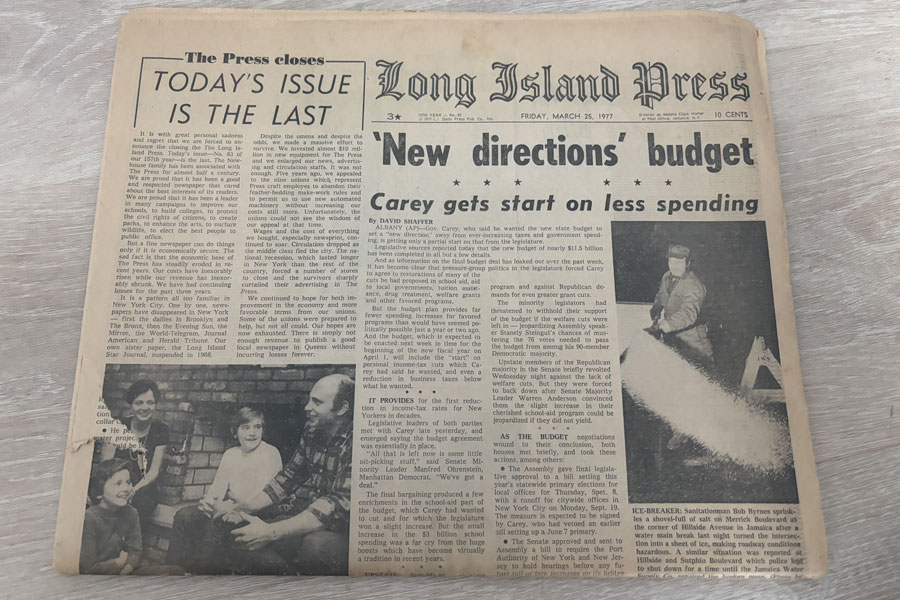
The Long Island Press, once a significant competitor, ceased publication in 1977. Its closure marked the consolidation of daily print dominance under Newsday within the Long Island market.
The decline of regional print competitors mirrored national trends in newspaper economics, as suburban dailies faced rising costs and competition from television news.
The Rise of Television News – The Broadcast Era
By the mid-20th century, Long Islanders increasingly consumed news from New York City television stations, including:
Although these stations covered Long Island stories, they did so as part of the broader New York metropolitan region. This dynamic meant that while Long Island had strong print identity through Newsday, its television coverage was integrated into the New York City media market.

Cable Innovation – News 12 Long Island
A major shift occurred in 1986 with the launch of News 12 Long Island, created by Cablevision.
News 12 was groundbreaking as:
- The first 24-hour regional cable news channel in the United States
- A station focused exclusively on Nassau and Suffolk counties
Its hyperlocal focus distinguished it from New York City broadcasters. Coverage centered on:
- Local crime
- Weather and traffic
- Town governance
- Community events
- School district issues
For many Long Islanders, News 12 became the primary television source for daily regional information.
The Digital Disruption – 2000s and Beyond
The arrival of widespread internet access in the late 1990s and early 2000s reshaped Long Island’s media environment.
Newsday Online
Newsday expanded digitally and later implemented a subscription paywall, becoming one of the more aggressive regional papers in limiting free access to content.
Hyperlocal Platforms
Digital platforms such as Patch launched in multiple Long Island communities, offering neighborhood-level reporting.
These sites attempted to replicate the hyperlocal model once served by weekly print newspapers.
Independent Digital Publishers
Over time, independent online publishers emerged covering:
- Real estate
- Crime reporting
- Political commentary
- Business
- Community features
The digital era decentralized media authority. No single institution now fully controls the Long Island narrative in the way Newsday once did in the mid-20th century.
Media Ownership and Market Structure
Long Island’s media market exists within the broader New York metropolitan media system. Major institutions are influenced by:
- Corporate media ownership
- Cable providers
- National broadcast networks
- Digital platform algorithms
This structure affects:
- Editorial priorities
- Revenue models
- Advertising markets
- Subscription strategies
As advertising shifted from print to digital platforms, traditional newspapers faced revenue contraction, resulting in staff reductions and restructuring – trends consistent with national media patterns.
The Collapse of Classified Advertising and the Shift to Online Platforms
Beginning in the late 1990s and accelerating through the early 2000s, the traditional business model that had sustained regional newspapers for decades began to erode. One of the most significant factors was the migration of classified advertising from print publications to online platforms.
For much of the 20th century, classified ads represented a major revenue source for newspapers serving Long Island, including employment listings, real estate offerings, automobile sales, and personal notices. These ads not only connected buyers and sellers within the community but also funded newsroom operations, investigative reporting, and local coverage.
The emergence of digital marketplaces fundamentally changed this system. Craigslist expanded into the New York metropolitan area in the late 1990s, offering free or low-cost listings that quickly attracted users away from paid newspaper classifieds. By the early 2000s, broadband internet access and search engines made online listings faster, cheaper, and more accessible than print.
In 2004, Backpage entered the market, further intensifying competition for classified advertising revenue across the United States, including Long Island. The combined impact of these platforms contributed to a sharp decline in print classified income between approximately 2000 and 2010.
This shift had significant consequences for regional media institutions. As advertising revenue contracted, newspapers faced staffing reductions, consolidation, and changes in editorial scope. Coverage increasingly prioritized major regional stories over hyperlocal reporting that had once been supported by classified income.
The migration of classifieds to digital platforms marked a turning point in Long Island’s media history, signaling the transition from a print-dominated information economy to a fragmented digital landscape in which traditional newspapers no longer held exclusive control over community marketplaces or public discourse.
How Media Has Shaped Long Island’s Identity
Over two centuries, media institutions have influenced:
- Public perception of suburban life
- Development debates
- Environmental protection movements
- Crime narratives
- Political campaigns
- Economic growth discussions
In the 20th century, a limited number of dominant outlets defined the daily agenda.
In the 21st century, the ecosystem has fragmented, with residents consuming information from:
- Traditional newspapers
- Cable news
- Broadcast television
- Digital publishers
- Social media
- Podcasts
The result is a more pluralistic but less centralized information environment.
Key Milestones in Long Island Media History
| Year | Development |
|---|---|
| 1821 | Founding of the Long Island Press |
| 1899 | Nassau County established, increasing need for regional news |
| 1940 | Founding of Newsday |
| 1977 | Closure of the Long Island Press |
| 1986 | Launch of News 12 Long Island |
| 2000s | Rapid shift toward digital and subscription-based models |
The Modern Long Island Media Landscape
Today, Long Island’s media environment consists of:
- A dominant regional daily newspaper
- A 24-hour hyperlocal cable network
- NYC-based broadcast affiliates
- Digital-first publishers
- Social media-driven information flows
While traditional institutions remain influential, narrative formation is increasingly shaped by digital distribution and audience fragmentation.
Long Island Media as Historical Record
From 19th-century town papers to modern streaming news platforms, media has served as the primary historical record of Long Island’s civic life. Newspapers documented the growth of Levittown, environmental battles over the Pine Barrens, school funding debates, and high-profile criminal cases. Television later amplified these stories to broader audiences.
Understanding Long Island’s media history provides insight into how residents have interpreted events, debated policy, and formed collective identity across generations.
Related: Digital News Sites Lead as Primary Source of News Among Long Island–Area Respondents, Local Survey Finds– Long Island Guide, John Colascione – 3/26/2026